

Having an FIR filed against you in Ghaziabad can be a stressful experience, but understanding the process helps you navigate it effectively. From the moment an FIR is registered, a series of legal steps follow, investigation, charge sheet, court proceedings, and possibly trial. This guide explains what happens after an FIR is filed in Ghaziabad and what you should do at each stage.
What Is an FIR?
A First Information Report (FIR) is the first written information of a cognizable offence given to the police. Under Section 154 of the Bharatiya Nyaya Sanhita, 2023 (formerly Section 154 CrPC), the police are bound to register an FIR if the information discloses a cognizable offence. In Ghaziabad, FIRs are registered at the local police station having jurisdiction over the area where the offence was committed.
Common reasons for FIRs in Ghaziabad include: property disputes escalating to criminal complaints, matrimonial disputes leading to false allegations, cheque bounce cases under Section 138 of the Negotiable Instruments Act, and cybercrime complaints.
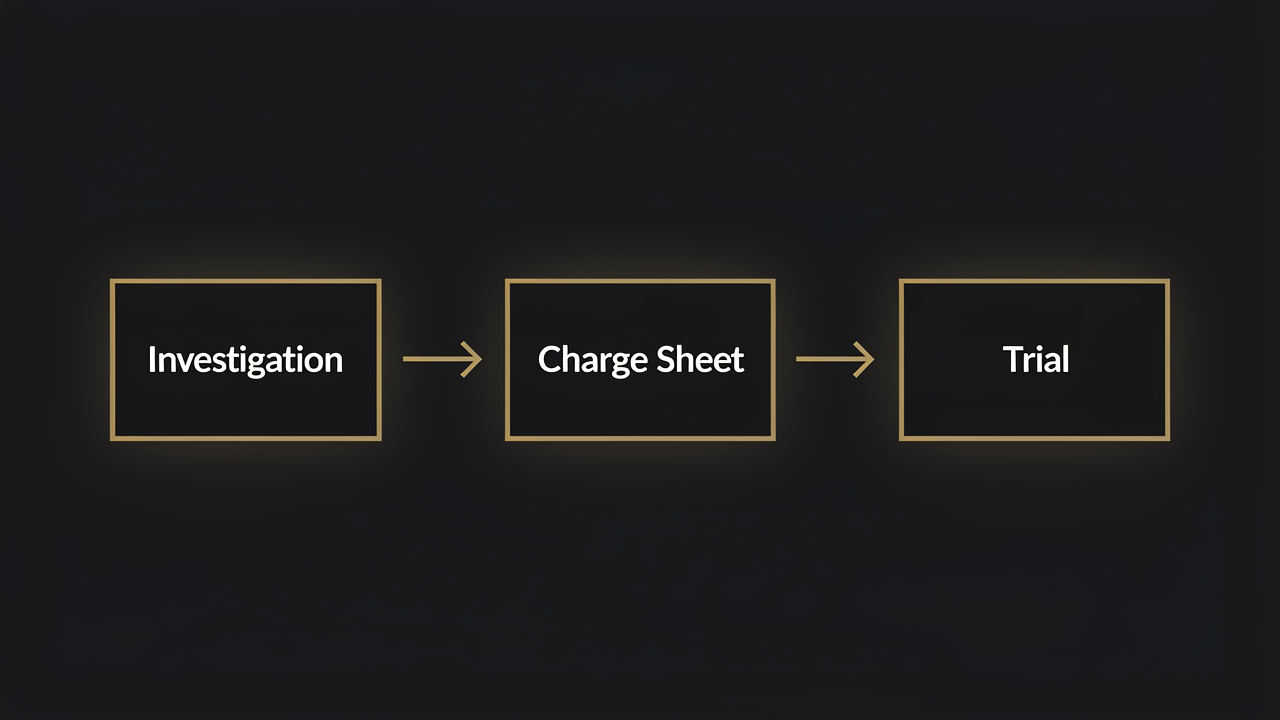
What Happens Immediately After an FIR Is Filed?
1. FIR Registration
The police register the FIR and assign a FIR number. You are entitled to a free copy of the FIR under Section 154(6) of the BNS. Read it carefully, the allegations and sections mentioned will determine the course of the investigation and your legal strategy.
2. Investigation Begins
The police begin investigation immediately after FIR registration. This may involve:
- Visiting the scene of the offence
- Collecting evidence (documents, CCTV footage, witness statements)
- Examining witnesses under Section 161 of the BNS
- Arresting the accused (if the offence is non-bailable or if the police believe you may abscond)
During investigation, you have the right to know the nature of the allegations and to engage a lawyer. Our criminal lawyers in Ghaziabad can monitor the investigation and protect your rights.
3. Summons or Arrest
If the offence is bailable, the police may issue a summons for you to appear before them. If the offence is non-bailable, the police may arrest you without a warrant. In such cases, you should immediately apply for bail through a criminal lawyer.
What Is a Charge Sheet?
After completing the investigation, the police file a charge sheet (Section 173 BNS) before the court. The charge sheet contains:
- Details of the investigation
- List of witnesses
- List of documents and evidence collected
- Charges framed against the accused
If the police find sufficient evidence, they file a charge sheet. If they find the complaint to be false, they file a final report under Section 173(2) BNS and close the case. Our FIR quashing lawyers in Ghaziabad can help you get a false FIR quashed under Section 528 of the BNS.
What Happens After the Charge Sheet?
Once the charge sheet is filed, the court takes cognisance of the offence and frames charges. The trial then proceeds, both the prosecution and the defence present their evidence, examine witnesses, and make arguments. If the court finds you guilty, it passes a sentence. If acquitted, you are discharged.
Your Rights After an FIR Is Filed
- Right to know the charges: You have the right to know the exact allegations and sections under which the FIR is registered
- Right to silence: You are not bound to answer questions that may incriminate you during police interrogation
- Right to legal representation: You have the right to engage a lawyer of your choice
- Right to bail: For bailable offences, bail is a right. For non-bailable offences, bail is at the discretion of the court
- Right to a fair trial: You are presumed innocent until proven guilty
Police Investigation Process in Ghaziabad — Detailed Steps
After the FIR is registered in Ghaziabad, the investigating officer (IO) takes over the case. The investigation process in Ghaziabad follows a structured procedure under the Bharatiya Nyaya Sanhita, 2023 (formerly CrPC):
- Scene of crime visit: The IO visits the scene of the incident to collect physical evidence, take photographs, and prepare a spot map
- Witness statements: The IO records statements of all witnesses under Section 180 BNS (formerly Section 161 CrPC). These statements cannot be used as evidence in court directly but are used to build the prosecution case
- Medical examination: If the offence involves physical injury, the IO arranges for a medical examination of the victim and the accused
- Collection of documents: The IO collects relevant documents such as CCTV footage, phone records, financial statements, or WhatsApp messages
- Arrest of accused: If the investigation reveals sufficient evidence, the IO arrests the accused. For non-bailable offences, the accused must apply for bail separately
The Ghaziabad police are required to complete the investigation and file a charge sheet within 90 days for cases involving offences punishable with imprisonment of more than 10 years, and within 60 days for other cases. Failure to file the charge sheet within the stipulated time can result in the accused being entitled to bail.
Charge Sheet and Its Contents
The charge sheet (previously called challan) is filed under Section 193 BNS (formerly Section 173 CrPC) once the police complete the investigation. The charge sheet includes:
- A detailed account of the investigation conducted
- Names and statements of all witnesses
- List of all documents and evidence collected
- Whether the offence is compoundable or non-compoundable
- The specific sections of law under which the accused is charged
After the charge sheet is filed, the court frames charges against the accused. The accused is then required to plead guilty or not guilty. If they plead not guilty, the trial proceeds with the prosecution presenting its evidence, followed by the defence. Our criminal lawyers in Ghaziabad represent clients at every stage of this process.
Quashing of FIR Under Section 528 BNS (formerly Section 482 CrPC)
Not every FIR leads to a valid trial. If you believe the FIR filed against you in Ghaziabad was filed with malafide intentions or if the allegations do not disclose any offence, you can file a quashing petition before the Allahabad High Court under Section 528 of the BNS. The High Court has inherent powers to quash FIRs and criminal proceedings to prevent abuse of the judicial process.
Common grounds for quashing an FIR in Ghaziabad include: settlement between the parties, FIR does not disclose any offence, FIR filed with mala fide intentions to harass, the dispute is civil in nature and does not warrant criminal proceedings, and the accused is falsely implicated due to family or business rivalry. Our advocates in Ghaziabad specialise in filing quashing petitions before the Allahabad High Court.
Police Custody vs. Judicial Custody — What’s the Difference?
When you are arrested after an FIR is filed in Ghaziabad, you may be placed in either police custody or judicial custody:
- Police custody: The accused is kept in the police lock-up for interrogation. This is typically granted for a maximum of 15 days. Police custody is sought when the police need to interrogate the accused to recover evidence, find hidden weapons, or identify co-accused
- Judicial custody: The accused is sent to jail under the court’s authority. This can be for a longer period, up to 90 days for non-bailable offences. The accused can apply for bail during judicial custody
If you have been named in an FIR in Ghaziabad, it is crucial to engage a lawyer immediately to apply for bail and prevent police custody. Our bail lawyers in Ghaziabad can help you navigate the bail process and protect your rights at every stage.
Your Legal Rights After an FIR Is Filed in Ghaziabad
Many people are unaware of their fundamental rights once an FIR is registered. Knowing these rights can prevent police abuse and protect your legal position:
Right to know the grounds of arrest (Section 41A BNS):
If the police intend to arrest you, they must inform you of the specific grounds and your right to bail. If the offence is bailable, you must be released on bail upon furnishing bail bonds.
Right to legal representation:
You have the right to be represented by a lawyer of your choice during police interrogation. Your lawyer cannot be present during interrogation, but you can consult them before and after. Our criminal lawyers in Ghaziabad advise clients on what to say and what not to say during questioning.
Right against self-incrimination (Article 20(3) of the Constitution):
You cannot be compelled to be a witness against yourself. You have the right to remain silent during interrogation. Anything you say can be used as evidence against you — exercise this right and consult a lawyer before making any statements.
Right to be produced before a Magistrate within 24 hours:
If you are arrested, the police must produce you before the nearest Magistrate within 24 hours of arrest, excluding travel time. This is a fundamental right under Article 22 of the Constitution.
Right to medical examination:
You have the right to request a medical examination if you have been subjected to physical abuse or torture during custody. Request this in writing to the Magistrate.
Related Legal Guides
Need Expert Legal Representation in Ghaziabad?
Advocate Nilesh Bijlani and the team at Bijlani & Co. handle all practice areas across Delhi NCR courts.
Consult an Advocate in GhaziabadFrequently Asked Questions
Related Legal Guides
Need Expert Legal Representation in Ghaziabad?
Advocate Nilesh Bijlani and the team at Bijlani & Co. handle all practice areas across Delhi NCR courts.
Consult an Advocate in GhaziabadCan the police deny you bail after an FIR is filed?
Yes, the police can deny bail for non-bailable offences. Bailable offences (like simple assault, minor theft) entitle the accused to bail as a matter of right. Non-bailable offences (like murder, rape, serious fraud) require the accused to apply for bail before a Magistrate or Sessions Court. Even for non-bailable offences, bail is not automatically denied — it is granted at the court’s discretion based on the facts of the case. Our bail lawyers in Ghaziabad can apply for bail immediately after FIR registration.
Can you get your FIR quashed after the police complete the investigation?
Yes, you can file a quashing petition even after the investigation is complete and the charge sheet is filed. However, quashing petitions are stronger when filed before the charge sheet — after the charge sheet, the court examines the evidence and the quashing petition becomes more difficult to succeed. Our FIR quashing lawyers in Ghaziabad can assess whether a quashing petition is viable at any stage of the investigation.
What happens if the police file a closure report instead of a charge sheet?
A closure report means the police could not find sufficient evidence to charge you with the offence. The magistrate can accept the closure report and close the case, or reject it and direct further investigation. If the magistrate accepts the closure report, you are free from the FIR. However, the complainant can challenge the closure report and request further investigation. Our lawyers can ensure that the closure report is accepted by the court and that you are discharged from the case.
Can an FIR be cancelled in Ghaziabad?
An FIR can be cancelled through a quashing petition under Section 528 of the BNS before the Allahabad High Court. Grounds for quashing include: the FIR does not disclose an offence, the FIR is filed with mala fide intentions, or the dispute is civil in nature and does not involve a criminal offence. Our FIR quashing lawyers in Ghaziabad can help you file a quashing petition.
How long does a police investigation take in Ghaziabad?
The police must complete the investigation within 60 days for offences punishable with imprisonment up to 10 years, and within 90 days for offences punishable with death, life imprisonment, or imprisonment exceeding 10 years. If the investigation is not completed within this time, you can apply for bail.
Can I get anticipatory bail if an FIR has already been filed?
Yes, as long as you have not been arrested. Once arrested, you can apply for regular bail. Our bail lawyers in Ghaziabad can help you with both anticipatory and regular bail applications.
What should I do immediately after an FIR is filed against me?
Engage a criminal lawyer immediately. Do not make any statements to the police without your lawyer present. Gather all evidence that supports your side of the story. Do not tamper with evidence or influence witnesses, this can lead to additional charges.
Criminal Legal Services in Ghaziabad
An FIR can have serious consequences for your personal and professional life. Our criminal lawyers in Ghaziabad can help you navigate the investigation, apply for bail, and defend you in court. Consult an advocate in Ghaziabad today.
Frequently Asked Questions
1. What are my rights after an FIR is filed against me in Ghaziabad?
You have: (1) Right to know arrest grounds (Section 41A BNS). (2) Right to legal representation. (3) Right against self-incrimination (Article 20(3)). (4) Right to be produced before Magistrate within 24 hours. (5) Right to medical examination if in custody. (6) Right to bail for bailable offences. (7) Right to a fair trial under Article 21.
2. What happens after an FIR is filed in Ghaziabad?
After FIR filing: (1) Police start investigation under Section 156 CrPC — collect evidence, record witness statements, visit crime scene. (2) If evidence found, police file charge sheet under Section 173 CrPC. (3) Court takes cognisance and frames charges. (4) Trial proceeds — prosecution and defence present evidence. (5) Verdict and sentencing. A criminal lawyer should be engaged immediately after FIR.
3. What is Section 41A BNS and what happens if I receive it?
Section 41A BNS requires police to issue a written notice instead of arresting you, for cognisable offences with less than 7 years punishment. You must appear on the specified date. Failure to appear can result in an arrest warrant. Always appear with a criminal lawyer in Ghaziabad. Do NOT make any statements without legal advice.
4. Can police deny bail after FIR is filed in Ghaziabad?
For bailable offences: police cannot deny bail. You must be released on bail upon furnishing bail bonds. For non-bailable offences: bail is decided by the Magistrate or Sessions Court. Police can oppose bail in court but the final decision rests with the judge. Engage a bail lawyer immediately after FIR.
5. What is a charge sheet and when is it filed?
A charge sheet (Section 173 CrPC) is filed by police after completing investigation. It contains: FIR details, names of accused and witnesses, list of documents and evidence collected, and police opinion on whether the accused committed the offence. It must be filed within 60-90 days. The court examines the charge sheet and decides whether to frame charges.
6. Can an FIR be quashed in Ghaziabad?
Yes, under Section 528 BNS (formerly Section 482 CrPC) in the Allahabad High Court. Grounds include: malicious intent to harass, false allegations, FIR does not disclose a cognisable offence, parties have settled, abuse of process. File before charge sheet for best results. Our FIR quashing lawyers in Ghaziabad specialise in this.
7. What is the difference between cognisable and non-cognisable offences?
Cognisable offences: police can arrest without warrant and start investigation without court permission (e.g., murder, rape, theft, assault). Non-cognisable offences: police cannot arrest without warrant and need court permission to investigate (e.g., defamation, cheating under Rs5000, simple hurt). The FIR format mentions this classification.
8. Can I get a copy of the FIR in Ghaziabad?
Yes, you have the right to obtain a copy of the FIR. Visit the police station where the FIR was filed and request a copy under RTI or directly from the SHO. Your lawyer can also obtain it on your behalf. Review the FIR carefully with your lawyer to understand the charges and plan your defence strategy.


