

Every child has the right to be maintained by their parents until they become financially independent. In Ghaziabad, child maintenance claims are filed before the Family Court or the Judicial Magistrate First Class court. Whether you are a mother seeking maintenance for your child from the father, or a guardian seeking maintenance for a child in your care, this guide explains the process for filing a child maintenance application in Ghaziabad.
Who Can Claim Child Maintenance in Ghaziabad?
Under Section 125 of the Bharatiya Nyaya Sanhita, 2023 (formerly Section 125 CrPC), the following people can claim child maintenance:
- Minor children: Both sons and daughters are entitled to maintenance until they turn 18 (or 21 if pursuing higher education)
- Adult children with disabilities: Children who are physically or mentally incapacitated can claim maintenance even after 18
- Guardians: If the parents are deceased or unable to maintain the child, a guardian can claim maintenance from the child’s relatives
Child Maintenance Process in Ghaziabad Family Court
Step 1: File the Maintenance Petition
The maintenance petition is filed before the Family Court in Ghaziabad or the JMFC court with jurisdiction over the respondent’s place of residence. The petition should include:
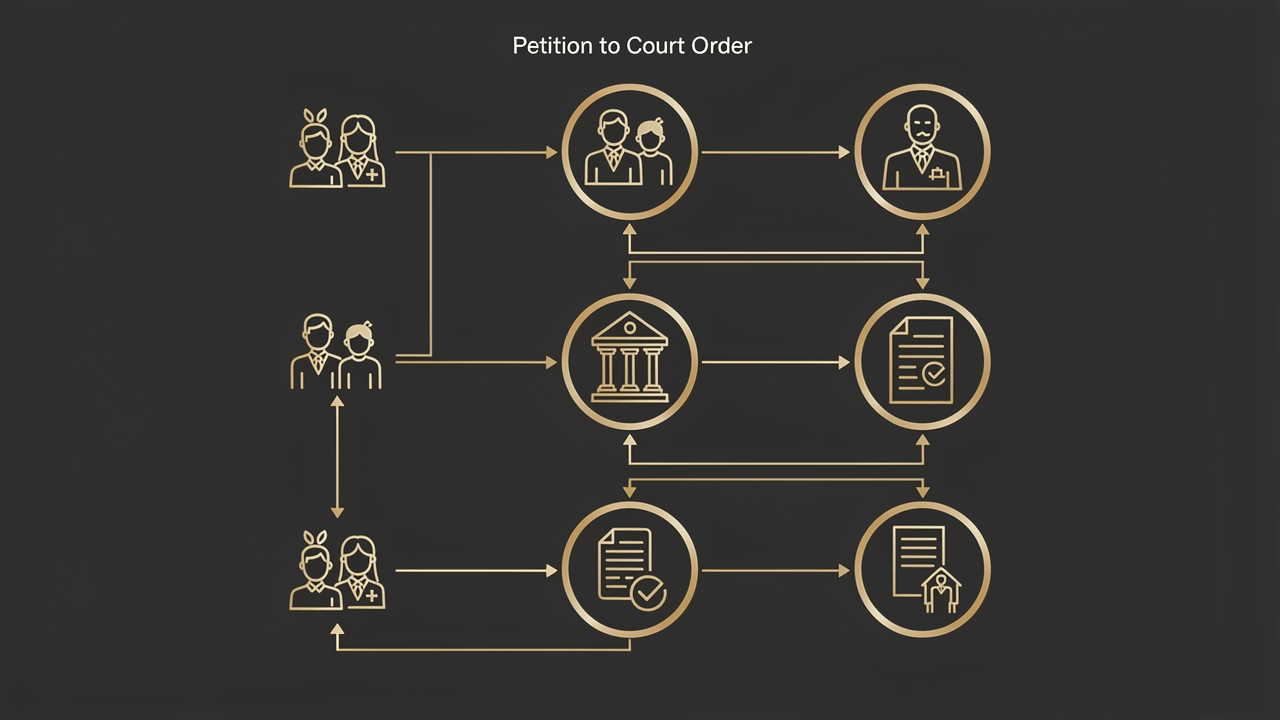
- Details of the child and both parents
- Income and assets of the father (or the parent from whom maintenance is claimed)
- Monthly expenses of the child (education, medical, food, clothing)
- Evidence of the father’s neglect or failure to maintain the child
Our child custody lawyers in Ghaziabad can help you draft a complete maintenance petition.
Step 2: Court Hearing and Summons
The court issues summons to the father, directing him to appear before the court. The father must file a written statement in response. The court then schedules dates for evidence and arguments.
Step 3: Evidence and Arguments
Both parties present evidence, income proof of the father, expenses of the child, and witness testimony. The court may also consider the child’s standard of living and educational needs.
Step 4: Maintenance Order
The court passes a maintenance order specifying the monthly amount to be paid. The amount is typically 25%–33% of the father’s net income. The order can be revised if the father’s income increases or the child’s needs change.
Factors Determining Child Maintenance Amount
- Father’s income: Salary, business income, rental income, and other sources
- Child’s needs: Education, medical care, food, clothing, and extracurricular activities
- Standard of living: The lifestyle the child was accustomed to before separation
- Number of children: Maintenance per child typically decreases as the number of children increases
- Mother’s income: If the mother is earning, her contribution is considered
Maintenance for Girl Children
Under the Hindu Adoption and Maintenance Act, 1956, a Hindu father is legally bound to maintain his daughter until she is married. After marriage, the daughter’s right to maintenance from her father ceases, but she can claim maintenance from her husband. However, if the daughter is divorced or separated, she can again claim maintenance from her father.
Who Can Claim Child Maintenance in Ghaziabad?
Under Section 125 of the Bharatiya Nyaya Sanhita, 2023 (formerly Section 125 CrPC), the following persons can claim child maintenance in Ghaziabad:
- Minor children: Both sons and daughters are entitled to maintenance until they turn 18 years old. Daughters are entitled to maintenance until they get married, even if they are above 18
- Adult children with disabilities: Children with physical or mental disabilities are entitled to maintenance even after turning 18
- Children pursuing higher education: The court may extend maintenance until the child completes their education, up to the age of 21
- Unmarried adult daughters: Unmarried daughters above 18 are entitled to maintenance until they get married or become financially independent
The application for child maintenance can be filed by the mother on behalf of the child, by the child through a guardian, or by any person who has custody of the child. In Ghaziabad, child maintenance applications are filed before the Family Court or the Judicial Magistrate First Class (JMFC) Court at the District Courts Complex.
How Child Maintenance Amount Is Determined in Ghaziabad
The court determines the maintenance amount based on several factors:
- Income and earning capacity of the parent (usually the father): The court looks at salary slips, ITR filings, business income, and other financial documents
- Needs of the child: Education expenses, medical expenses, daily living costs, and other reasonable requirements
- Standard of living: The lifestyle the child was accustomed to during the parents’ marriage or relationship
- Number of children: The maintenance amount is divided among all children if there are multiple claimants
- Other obligations: The parent’s other financial obligations (to elderly parents, second family, etc.)
In Ghaziabad, the court typically awards 25–30% of the father’s net income as child maintenance for each child. For example, if the father earns ₹50,000 per month, the maintenance for one child would typically be ₹12,500–₹15,000 per month. The amount increases with the number of children and the father’s income level.
Procedure for Filing Child Maintenance Application in Ghaziabad
The procedure for filing a child maintenance application in Ghaziabad is straightforward:
- Draft the application: The application should include details of the child, the parent from whom maintenance is claimed, the relationship, the child’s needs, and the parent’s financial capacity
- Attach supporting documents: Birth certificate of the child, income proof of the parent, proof of residence, and any other relevant documents
- File before the court: Submit the application at the Family Court or JMFC Court in Ghaziabad
- Pay court fees: Court fees for maintenance applications are nominal, typically ₹50–₹200
- Summons to the respondent: The court issues summons to the parent from whom maintenance is claimed
- Hearing: Both parties appear before the court, and the judge passes an interim or final order
In many cases, the court passes an interim maintenance order immediately, directing the parent to pay a specific amount per month pending the final decision. This interim order is binding and enforceable from the date it is passed.
Enforcement of Child Maintenance Orders in Ghaziabad
If the parent from whom maintenance is claimed fails to pay the maintenance amount, the following enforcement steps can be taken in Ghaziabad:
- Execution petition: File an execution petition before the same court that passed the maintenance order
- Attachment of salary: The court can direct the employer of the defaulting parent to deduct maintenance from their salary and deposit it directly with the court
- Attachment of property: The court can attach the defaulting parent’s property and sell it to recover arrears
- Arrest and detention: In cases of willful default, the court can issue a warrant for the arrest and detention of the defaulting parent until they comply with the order
- Defamation complaint: Filing a complaint under Section 125(3) CrPC for willful neglect
Our maintenance lawyers in Ghaziabad are experienced in both filing and enforcing child maintenance orders, ensuring that your child receives the support they deserve.
Child Maintenance After Divorce
In cases of divorce, child maintenance is typically addressed as part of the divorce decree. However, if maintenance was not addressed in the divorce proceedings, or if the maintenance order needs to be modified due to changed circumstances, a separate application can be filed in the Ghaziabad Family Court under Section 125 BNS or Section 24 of the Hindu Marriage Act.
Modification of maintenance orders is allowed when there is a significant change in circumstances, such as a substantial increase or decrease in the parent’s income, a change in the child’s needs, or the child reaching the age of majority. Our maintenance lawyers in Ghaziabad can help you apply for modification of maintenance orders when circumstances change.
How Much Maintenance Can You Claim in Ghaziabad?
A common question is the quantum of maintenance. While the court decides the exact amount, here are the guidelines and precedents:
For wives under Section 125 BNS:
The court considers: the husband’s income and standard of living, the wife’s own income and earning capacity, the number of dependents, and the wife’s health and needs. Typically, courts award 1/3rd to 1/4th of the husband’s net income as monthly maintenance. For high-income earners in Ghaziabad, this can range from ₹15,000 to ₹75,000 per month.
For children under Section 125 BNS:
Child maintenance is calculated based on: the child’s needs (education, healthcare, lifestyle), both parents’ financial capacity, and the child’s accustomed standard of living. Courts typically award 1/5th to 1/3rd of the combined parental income.
Custody vs guardianship:
Physical custody (where the child lives) and legal guardianship (decision-making authority) can be split between parents. The court may grant physical custody to one parent while ordering that both parents share legal guardianship for major decisions.
Can maintenance be increased later?
Yes. If the husband’s income increases significantly after the initial order, the wife or child can file a modification application demonstrating the changed circumstances. Courts regularly grant enhancement applications when supported by evidence of income growth.
Related Legal Guides
Need Expert Legal Representation in Ghaziabad?
Advocate Nilesh Bijlani and the team at Bijlani & Co. handle all practice areas across Delhi NCR courts.
Consult an Advocate in GhaziabadFrequently Asked Questions
Related Legal Guides
Need Expert Legal Representation in Ghaziabad?
Advocate Nilesh Bijlani and the team at Bijlani & Co. handle all practice areas across Delhi NCR courts.
Consult an Advocate in GhaziabadWhat is the difference between maintenance and alimony in Ghaziabad?
Maintenance is a periodic payment made during the marriage or after divorce for the support of a spouse or child. It is governed by Section 125 of the BNS. Alimony is a one-time or periodic payment made at the time of divorce as part of the settlement. It is governed by personal laws and the Divorce Act. In practice, the terms are often used interchangeably. Both types of payments are designed to ensure that the dependent spouse or child does not face financial hardship.
Can a wife claim maintenance without filing for divorce?
Yes, a wife can claim maintenance from her husband without filing for divorce. Maintenance under Section 125 of the BNS is available to wives, children, and parents who are unable to maintain themselves. A deserted wife can file a maintenance application even while the marriage subsists. The husband is legally obligated to maintain his wife during the marriage — this obligation does not end with desertion. Our maintenance lawyers in Ghaziabad can file a maintenance petition without affecting the marriage.
Can maintenance be increased if the husband’s income increases?
Yes, maintenance can be increased if the husband’s income increases significantly after the initial order. The wife or child can file a modification application in the same court that passed the maintenance order, demonstrating the increase in the husband’s income and the changed circumstances. The court will review the current needs and the husband’s enhanced capacity to pay and adjust the maintenance amount accordingly.
Can a mother claim child maintenance without filing for divorce?
Yes. A mother can file a Section 125 application for child maintenance independently, without filing for divorce. The application can be filed even if the parents are living together but the father is neglecting to maintain the child.
Up to what age can a child claim maintenance?
A child can claim maintenance until 18 years of age. If the child is pursuing higher education or is physically/mentally disabled, the court may extend maintenance up to 21 years or beyond.
Can child maintenance be claimed from the mother?
Yes. If the mother has sufficient income and the father is deceased or unable to pay, the child can claim maintenance from the mother. The court considers the financial capacity of both parents.
Can maintenance be claimed for a child born out of wedlock?
Yes. Both parents are legally bound to maintain a child born out of wedlock. The mother can file a maintenance application against the biological father under Section 125 BNS.
Need a Child Maintenance Lawyer in Ghaziabad?
Child maintenance cases require a clear presentation of financial evidence and a strong legal argument. Our maintenance lawyers in Ghaziabad can help you file a child maintenance application and ensure your child receives the financial support they deserve. Consult an advocate in Ghaziabad today.
Frequently Asked Questions
1. How much child maintenance can I claim in Ghaziabad?
Child maintenance under Section 125 BNS is typically 1/5th to 1/3rd of the combined parental income. For one child, this ranges from Rs5,000 to Rs25,000 per month depending on parents’ income and the child’s needs (education, healthcare, lifestyle). For multiple children, the amount increases proportionally. High-income families in Ghaziabad may see awards of Rs30,000-Rs50,000 per month for 2-3 children.
2. What is the difference between maintenance and alimony in Ghaziabad?
Maintenance (Section 125 BNS): for wife and children during marriage or after separation. A right during subsistence of marriage. Can be claimed without divorce. Alimony (Section 24/25 Hindu Marriage Act): one-time or periodic payment after divorce. Not available during marriage. Maintenance is broader and more accessible — alimony is specific to divorce proceedings.
3. Can a wife claim maintenance without divorce in Ghaziabad?
Yes, under Section 125 BNS of the Bharatiya Nyaya Sanhita, a wife can claim maintenance without filing for divorce. She can also claim under Section 18 of the Hindu Adoption and Maintenance Act, 1956 or Section 24 of the Hindu Marriage Act during divorce proceedings. The husband’s income, lifestyle, and the wife’s needs are considered by the court.
4. Can child maintenance be increased later?
Yes, file a modification application under Section 127 BNS if the paying parent’s income increases significantly or the child’s needs increase (higher education, medical expenses). Courts regularly grant enhancement when supported by evidence: income tax returns, salary increments, school fee hikes, medical bills. File through a maintenance lawyer in Ghaziabad.
5. What is Section 125 BNS and who can claim under it?
Section 125 BNS (formerly Section 125 CrPC) provides for maintenance to: wife (if unable to maintain herself), minor children (regardless of sex), adult children with physical or mental disabilities, and aged parents. The Magistrate can order monthly or lump-sum maintenance. The wife can claim even if living separately from the husband.
6. What are the grounds for maintenance refusal?
Maintenance can be refused if: the wife is earning sufficiently and is self-dependent, the wife deserted the husband without reasonable cause, the wife is living in adultery, the wife refused to live with the husband without justification, or the husband proves the wife has sufficient means to maintain herself. However, even earning wives may get maintenance if the husband’s income is significantly higher.
7. How is maintenance calculated for working wives?
If the wife is employed, the court considers: her income vs husband’s income gap, her earning capacity vs husband’s standard of living, the child’s needs regardless of mother’s income, and the husband’s obligation to maintain the family accustomed standard of living. Typically, maintenance is reduced by 20-40% for working wives but not eliminated unless she is fully self-sufficient.
8. Can maintenance stop after remarriage of the wife?
No, maintenance for children does not stop if the wife remarries — the father’s obligation to maintain his children continues regardless of the mother’s remarriage. Maintenance for the wife herself may be reviewed after remarriage, but if the wife remarries to a person with similar or lower income, maintenance may continue.


