
Child Custody Lawyer in Ghaziabad: Custody Rights, Guardianship, and the Welfare Standard
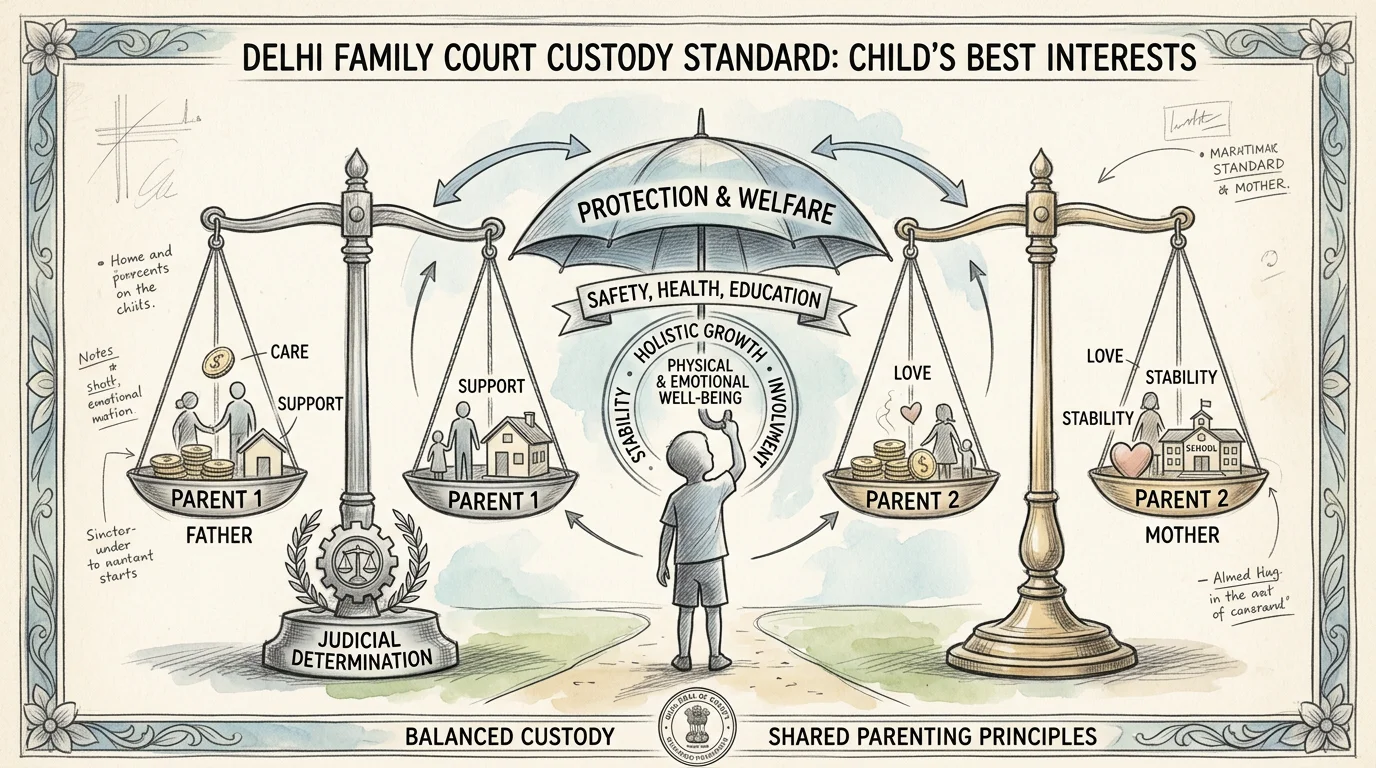
Child custody is one of the most sensitive family law matters in Ghaziabad. When parents separate or divorce, determining where the children will live and how the non-custodial parent will maintain access becomes a priority. The law in India does not automatically grant custody to the mother or the father. The court applies the welfare of the child as the top-priority standard. This standard considers the child’s age, emotional ties with each parent, each parent’s capacity to provide a stable home, financial resources, moral character, and educational opportunities. A child custody lawyer in Ghaziabad who understands how this standard is applied in practice can present a compelling case that advances your parenting goals while protecting your child’s best interests.
Bijlani & Co. represents both mothers and fathers in child custody proceedings before the Ghaziabad Family Court, the District Court, and the Allahabad High Court. We handle cases under the Hindu Minority and Guardianship Act, 1956, the Guardians and Wards Act, 1890, and the Special Marriage Act, 1954. We also handle custody disputes that arise outside divorce proceedings — between unmarried parents, involving grandparents, and for modification of existing custody orders. Our child custody lawyers in Ghaziabad combine legal strategy with practical advocacy to achieve outcomes that serve the child’s welfare and our client’s parental rights.

Types of Child Custody Under Indian Family Law
Indian family law recognises several types of custody arrangements, each serving a different purpose. Physical custody means the child lives primarily with one parent. The non-custodial parent typically has visitation rights on specified days. Physical custody is the most common arrangement, particularly for young children who need consistent primary caregiving. The custodial parent is responsible for the child’s day-to-day care, education, and healthcare decisions within the scope of the custody order.
Joint custody means the child spends significant time with both parents according to a court-approved schedule. Joint custody arrangements typically specify weekday and weekend schedules, holiday divisions, summer vacation arrangements, and special occasion provisions. The court can order shared legal custody as well, meaning both parents participate in major decisions about the child’s education, healthcare, and religious upbringing. Joint custody has become increasingly common as courts have recognised that children benefit from meaningful relationships with both parents, provided both parents are fit and cooperative.
Sole custody is granted when the court determines that one parent is better suited to make all decisions for the child. Courts grant sole custody when one parent has a history of abuse, neglect, substance abuse, or criminal activity, or when the other parent has abandoned the child. The non-custodial parent may still have visitation rights, which can be supervised or unsupervised depending on the court’s assessment. Visitation rights in Ghaziabad courts are typically structured to include alternate weekends, one weekday evening per week, and shared major holidays.
Legal custody refers specifically to the authority to make major decisions for the child — education, healthcare, and religious upbringing. Legal custody can be sole or joint. A parent with legal custody can choose the child’s school, approve medical treatment, and decide on religious instruction. Even a parent without physical custody can have legal custody if the court determines that this arrangement serves the child’s welfare.
The Welfare Standard: How Ghaziabad Courts Decide Custody
The welfare of the child is the top-priority consideration in every custody decision under both the HMGA and the GWA. The court does not begin with any presumption favouring the mother or the father. Instead, the court examines the specific facts of each case and determines which arrangement best serves the child’s welfare. The welfare standard is broadly defined and encompasses multiple factors. The child’s age and developmental needs are the starting point. Infants and very young children typically benefit from the primary caregiving of their mother, and Ghaziabad courts have consistently recognised this. As children grow older, their own preference becomes more relevant.
The emotional attachment between the child and each parent is another critical factor. Courts examine evidence of active parenting — who attends school events, who manages the child’s healthcare, who provides day-to-day care. A parent who has been actively involved in the child’s upbringing has a stronger case for custody than a parent who was largely absent. Each parent’s capacity to provide a stable home environment is assessed — the quality of housing, proximity to the child’s school, availability of support from extended family, and the overall safety of the home.
Hindu Minority and Guardianship Act, 1956 vs Guardians and Wards Act, 1890
Custody proceedings in Ghaziabad can be filed under two different statutes. The Hindu Minority and Guardianship Act, 1956 applies to Hindus, Buddhists, Jains, and Sikhs. Under Section 6 of the HMGA, the father is the natural guardian of a legitimate child. However, for children under five years old, the mother has preferential custody. This preference reflects the court’s recognition that very young children need the primary care of their mother. The HMGA also specifies that the father’s guardianship takes precedence after the child reaches five years old, though the welfare standard remains top-priority and can override this provision.
The Guardians and Wards Act, 1890 applies to all communities and is a secular statute. Under the GWA, the court has wider discretion to appoint a guardian based on the child’s welfare, without any statutory preference based on the parent’s gender or religion. The GWA is the appropriate forum for inter-faith families, for families where the parents belong to different religious communities, and for cases involving unmarried parents or third-party custody applications. Our child custody lawyers in Ghaziabad advise on the appropriate statute for each case based on the family’s religious composition and the specific custody issues involved.
Visitation Rights: Structure and Enforcement in Ghaziabad
Visitation rights are a critical component of every custody arrangement. The non-custodial parent’s right to spend meaningful time with their child is protected by law. Visitation schedules typically include alternate weekends, one weekday evening per week, shared major festivals and holidays, and summer vacation arrangements. The court can order supervised visitation if there are concerns about the non-custodial parent’s suitability for unsupervised access with the child. Supervised visitation takes place in the presence of a court-appointed supervisor or at a designated facility.
Visitation orders are enforceable, and our child custody lawyers in Ghaziabad file enforcement applications when the custodial parent denies visitation without valid cause. The court can impose sanctions for non-compliance with visitation orders, including modification of the custody arrangement. We also negotiate visitation schedules that are practical for both parents — not just legally adequate but actually workable given work schedules, distance, and the child’s school calendar.
Custody Modification: When Circumstances Change After the Order
Custody orders are not permanent. When circumstances change significantly — when one parent relocates to another city or country, when the child’s educational or healthcare needs change substantially, when one parent’s behaviour becomes unsuitable for continued custody, or when the child expresses a strong preference for a change — the existing order can be modified. Modification proceedings are filed before the same court that passed the original order, and the applicant must demonstrate that the changed circumstances materially affect the child’s welfare. Our child custody lawyers in Ghaziabad handle modification proceedings, presenting updated evidence and arguing for an arrangement that continues to serve the child’s welfare under the new circumstances.
International Child Abduction and Hague Convention Cases
Child abduction occurs when one parent takes or retains a child outside India in violation of the other parent’s custody rights. India is a signatory to the Hague Convention on the Civil Aspects of International Child Abduction, and the Allahabad High Court has jurisdiction to order the return of an abducted child to the country of habitual residence. Our child custody lawyers in Ghaziabad handle Hague Convention cases, filing petitions before the Allahabad High Court for the return of children who have been taken abroad. We also advise on preventive measures — passport restrictions, court orders preventing international travel, and custody agreements that address the consequences of relocation. Prevention is always more effective than remedy in international abduction cases.
Why Choose Bijlani & Co. for Child Custody in Ghaziabad
Child custody cases require more than legal knowledge. They require evidence presentation that convinces the court that your proposed arrangement is in the child’s welfare, not just your personal preference. Our child custody lawyers in Ghaziabad prepare custody cases with detailed evidence — witness statements from family members, teachers, and neighbours, documentation of the parent’s involvement in the child’s education and healthcare, and expert opinions where appropriate. We also negotiate custody arrangements that are practical for both parents and the child, reducing the adversarial nature of custody disputes and preserving the parent-child relationship.
At what age can a child decide which parent to live with?
There is no fixed age in Indian law. Ghaziabad courts typically give weight to a child’s preference if they are approximately 13 years or older, but the court’s primary consideration remains the child’s welfare. A mature minor above 13 can express a preference, and the court considers it alongside other welfare factors. Our child custody lawyers help children express their preference in a manner that the court can appropriately consider.
Can grandparents get custody of a child in Ghaziabad?
Yes. Grandparents can apply for custody or visitation rights under the Guardians and Wards Act. The court considers the grandparents’ ability to provide a stable home and whether awarding custody to grandparents serves the child’s welfare better than the parents. Our child custody lawyers in Ghaziabad handle grandparent custody cases and advise on the specific procedural requirements.
Can a custody order be enforced if the other parent has taken the child to another city?
Yes. A custody order from a Ghaziabad court is enforceable throughout India. If the other parent has taken the child to another city, our child custody lawyers file an application for enforcement before the court in the city where the child is located, requesting that the custody order be executed and the child returned to the custodial parent.
What is the difference between custody and guardianship?
Custody refers to the physical care and control of the child — where the child lives and who provides day-to-day care. Guardianship is the legal authority to make major decisions for the child — education, healthcare, and property. A parent can have custody without guardianship, or guardianship without physical custody. Our child custody lawyers advise on both dimensions and ensure that our clients’ rights are protected in both.
Need a Child Custody Lawyer in Ghaziabad?
Bijlani & Co. handles child custody, guardianship, visitation rights, and custody modification across Ghaziabad Family Court and Allahabad High Court. Contact us for a consultation.
Phone: 085958 09471
Email: write@bijlani.in
Office: 141 Patiala House Courts, New Delhi
Related Practice Areas
Family Lawyer Ghaziabad
Complete family law: divorce, custody, maintenance, DV Act, and ADR in Ghaziabad.
Divorce Lawyer Ghaziabad
Section 13, 13B Hindu Marriage Act — child custody is a core component of divorce.
Maintenance Lawyer Ghaziabad
Section 125 BNS maintenance linked to custody determinations and child welfare.
Documentation Needed for Child Custody Cases in Ghaziabad
Strong documentation is the foundation of any successful child custody case in Ghaziabad family court. The court evaluates evidence across multiple dimensions: financial capacity (salary slips, income tax returns, bank statements), living conditions (rent agreement, photographs of the home, neighbourhood safety), character and fitness (no criminal record, evidence of responsible parenting), child’s welfare (school records, medical records, teacher references), and relationship history (evidence of involvement in the child’s daily life, school events, medical appointments). A child custody lawyer will help you organise this evidence into a compelling case. Photographs and videos showing you with the child in everyday situations are powerful evidence. Witness affidavits from teachers, doctors, neighbours, and family members add credibility. The more detailed and well-organised your evidence package, the stronger your case for custody or visitation rights in Ghaziabad family court.
Supervised Visitation and Restricted Access Orders
When the court determines that a parent’s access to the child should be limited — but not eliminated — it can pass a supervised visitation order. Under this order, the non-custodial parent is allowed to meet the child only in the presence of a court-appointed supervisor or a designated family member. The supervision ensures the child’s safety while maintaining the parent-child relationship. Ghaziabad family courts use supervised visitation when there are concerns about the non-custodial parent’s behaviour, mental health, or substance abuse. The order specifies: the days and hours of visitation, the location of visits (the court may designate a neutral venue), the identity of the supervisor, and the conditions under which unsupervised visitation may be considered in the future. A child custody lawyer in Ghaziabad will argue for supervised visitation when full custody to the other parent is not in the child’s best interests, and will structure the order to protect the client’s ongoing relationship with the child while ensuring safety.
Need a lawyer? Consult our advocate in Ghaziabad for expert legal representation across all practice areas. We also specialise in Child Custody Lawyer Ghaziabad | Bijlani matters.
Related Legal Guides
Need Expert Legal Representation in Ghaziabad?
Advocate Nilesh Bijlani and the team at Bijlani & Co. handle all practice areas across Delhi NCR courts.
Consult an Advocate in GhaziabadRelated Practice Areas
Explore our full range of legal services across Delhi NCR.