
Family Lawyer in Ghaziabad: Divorce, Custody, Maintenance, and Matrimonial Disputes
Family law matters in Ghaziabad touch the most personal aspects of your life. Divorce, child custody, maintenance, and domestic violence cases carry emotional weight alongside complex legal frameworks. A family lawyer in Ghaziabad who handles these matters must understand the relevant statutes — the Hindu Marriage Act, 1955, the Hindu Adoption and Maintenance Act, 1956, the Special Marriage Act, 1954, the Protection of Women from Domestic Violence Act, 2005, and the Guardians and Wards Act, 1890 — and must also understand how the Ghaziabad Family Court and District Court apply these statutes in practice. Bijlani & Co. has built a dedicated family law practice across Delhi NCR, with regular appearances before the Ghaziabad Family Court. We represent both husbands and wives in divorce proceedings, both parents in custody disputes, and both applicants and respondents in protection order matters. We believe that every client deserves vigorous advocacy regardless of the position they occupy.
The Ghaziabad Family Court has specific procedural requirements. Case numbering, filing timelines, hearing schedules, and registry procedures all follow the court’s internal practices. An advocate who regularly appears before the Ghaziabad Family Court knows how to file for the earliest hearing date, how to present evidence in a format the judges expect, and which procedural shortcuts are available. This practical knowledge translates into faster progress for your case. Our family lawyers in Ghaziabad have developed this knowledge through years of regular appearances, and our clients benefit from it at every stage of their case.

Divorce Under the Hindu Marriage Act, 1955: Mutual Consent and Contested Proceedings
The Hindu Marriage Act, 1955 provides for two routes to divorce. Mutual consent divorce under Section 13B requires that both parties agree to the divorce and have lived separately for at least one year. The one-year separation period is a strict statutory requirement, though living in the same household under the same roof does not prevent the clock from running if the parties are living as strangers. The mutual consent divorce process requires two court appearances, with a minimum six-month cooling-off period between the first and second motion. The court can waive the six-month period if it is satisfied that the marriage has irretrievably broken down and that continued delay would cause undue hardship to either party.
Contested divorce under Section 13(1) requires the petitioner to prove one of the statutory grounds. The most common grounds in Ghaziabad are adultery under Section 13(1)(i), cruelty under Section 13(1)(ia), and desertion under Section 13(1)(ib). Adultery requires proof that the respondent had sexual intercourse with a third party during the subsistence of the marriage. The evidence must go beyond suspicion — it must establish the fact of adultery. Cruelty covers both physical and mental cruelty. Mental cruelty includes persistent humiliation, constant harassment, denial of marital rights, and any conduct that makes it unreasonable for the petitioner to continue living with the respondent. Desertion requires two years of continuous separation with animus deserendi — a settled intention to abandon the marriage permanently. Our family lawyers in Ghaziabad build contested divorce cases on the applicable statutory ground, presenting witness testimony, documentary evidence, and cross-examination that establishes the ground beyond reasonable doubt.
Child Custody: Welfare Standard Under Hindu Minority and Guardianship Act
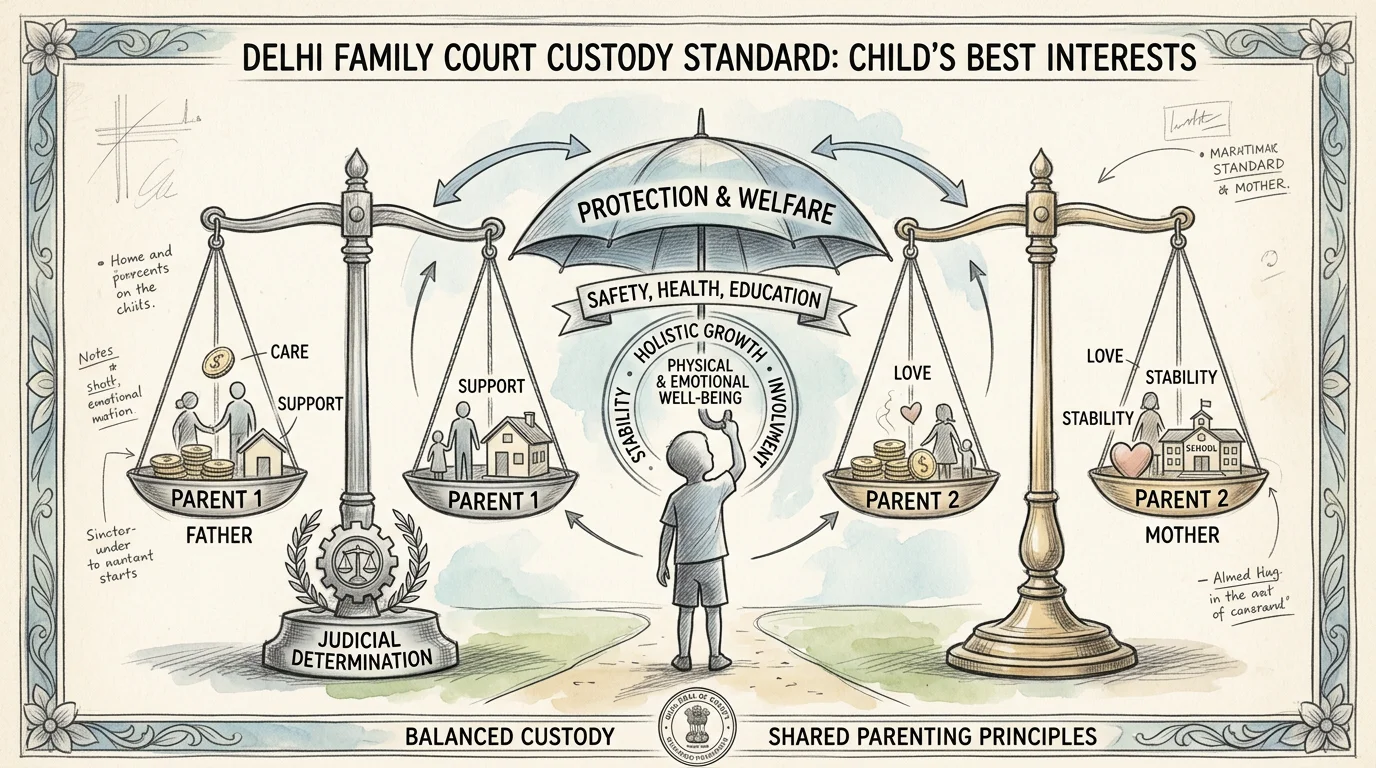
Child custody disputes in Ghaziabad are governed primarily by the Hindu Minority and Guardianship Act, 1956 and the Guardians and Wards Act, 1890. Both statutes apply the welfare of the child as the top-priority consideration. The court does not start with a presumption that custody should go to the mother or the father. Instead, the court examines the specific facts and determines which arrangement best serves the child’s welfare. Factors considered include the child’s age, emotional attachment to each parent, each parent’s capacity to provide a stable home, financial resources, moral character, educational opportunities, and the child’s own preference if old enough to express one. For very young children, Ghaziabad courts tend to grant physical custody to the mother, reflecting the importance of maternal care in early childhood. As children grow older, the courts are more willing to consider joint custody or custody with the father, particularly when both parents have been actively involved in the child’s upbringing.
Physical custody means the child lives with one parent primarily. Joint custody divides time between both parents. Legal custody is the authority to make major decisions. Visitation rights allow the non-custodial parent access to the child on specified terms. Our child custody lawyers in Ghaziabad present evidence on each of these dimensions, negotiate arrangements that are practical for both parents, and enforce court orders when the other parent is uncooperative. We also handle custody modification proceedings when circumstances change — when a parent relocates, when a child’s educational needs change, or when one parent’s behaviour becomes unsuitable for continued custody.
Maintenance: Section 125 BNS, Section 24, and Section 25 of Hindu Marriage Act
Maintenance law in Ghaziabad operates through three main provisions. Section 125 BNS provides for interim maintenance for wives, children, and parents who cannot maintain themselves. This is a summary procedure that does not require a full civil trial, making it the fastest route to financial relief. Interim maintenance under Section 125 can be claimed during the divorce proceedings, and the order continues even after divorce unless specifically extinguished by the court. The amount is typically 25-33% of the respondent’s net monthly income for wives and covers education, healthcare, and living expenses for children. Section 24 of the Hindu Marriage Act provides for maintenance during the pendency of divorce proceedings. Section 25 provides for permanent maintenance after divorce, which can be a lump sum or periodic payment. Our family lawyers in Ghaziabad prepare detailed financial affidavits that establish the appropriate maintenance amount and present evidence of the respondent’s actual income.
Protection of Women from Domestic Violence Act, 2005: Civil Remedy
Domestic violence cases often overlap with divorce proceedings. The Protection of Women from Domestic Violence Act, 2005 provides a civil remedy for women facing physical, emotional, economic, and sexual abuse. Protection orders under Section 18 prohibit the respondent from committing further violence, entering the shared household, or communicating with the petitioner. Residence orders under Section 19 can direct the respondent to provide alternate accommodation or to vacate the shared household. Monetary relief under Section 20 covers compensation for losses and monthly maintenance. Custody orders under Section 21 can grant temporary custody of children to the woman. Our family lawyers in Ghaziabad file protection applications on an emergency basis and seek interim orders within days. We document every incident of abuse with medical records, police reports, and witness statements.

Special Marriage Act: Divorce for Inter-Faith Couples in Ghaziabad
The Special Marriage Act, 1954 provides a civil framework for marriage and divorce that applies to all faiths. Couples who married under their personal law can choose to divorce under the SMA. The grounds are the same as the Hindu Marriage Act: adultery, cruelty, desertion, conversion, unsoundness of mind, venereal disease, and irretrievable breakdown. Mutual consent divorce under the SMA follows the same one-year separation requirement and six-month cooling-off period. Our family lawyers in Ghaziabad handle divorce proceedings under the SMA for inter-faith couples and for clients who prefer the civil framework.
Alternative Dispute Resolution and Court Procedures in Ghaziabad Family Court
The Ghaziabad Family Court actively promotes mediation as an alternative dispute resolution mechanism. Couples who reach a settlement through mediation save time, reduce costs, and maintain control over the outcome. Our family lawyers are trained in mediation and skilled negotiators. We prepare clients for mediation sessions, develop a negotiation strategy, and ensure that any settlement is properly documented and enforceable. When mediation fails or is not appropriate, we proceed to trial with full preparation. We also handle post-judgment matters — enforcement of maintenance orders, modification of custody arrangements, and execution of property division orders — so that the court’s judgment translates into practical results for our clients.
Why Choose Bijlani & Co. as Your Family Lawyer in Ghaziabad
Family law matters require more than legal knowledge. They require empathy, patience, and the ability to guide clients through emotionally difficult decisions. Our family lawyers in Ghaziabad take the time to understand your goals and priorities, explain the legal options clearly without jargon, and advise on the strategy most likely to achieve the outcome you want. We handle all aspects of family law — divorce, custody, maintenance, protection orders, and related criminal proceedings — so that you have a single point of contact. Our office at 141, Patiala House Courts, New Delhi, serves as our base for all Delhi NCR matters, and we regularly appear before the Ghaziabad Family Court for proceedings. We provide clear case updates, realistic timelines, and honest assessment of your position at every stage.
How long does a divorce case take in Ghaziabad Family Court?
Mutual consent divorce takes 6-18 months in Ghaziabad. Contested divorce cases take 2-5 years depending on complexity and the evidence required. Our family lawyers prioritise negotiation where possible to reduce the timeline. If trial is necessary, we prepare thoroughly and present a strong case from day one.
Can a husband claim maintenance from his wife in Ghaziabad?
Yes, in limited circumstances. Under Section 25 of the Hindu Marriage Act, a husband can claim maintenance if he is unable to maintain himself and the wife has sufficient means. The court applies a stricter standard for male applicants than for wives under Section 125 BNS. Our family lawyers assess the strength of a husband’s maintenance claim during the initial consultation.
What documents are needed for a child custody case?
You will need the child’s birth certificate, both parents’ identity and address proof, income proof, school records, evidence of your involvement in the child’s upbringing, and any prior court orders. Our family lawyers prepare a complete document checklist at the start of every custody engagement and verify that all documents are in order before the petition is filed.
Can I file for divorce if my spouse is not cooperating?
Yes. If your spouse refuses to cooperate with mutual consent divorce, you can file a contested divorce on grounds such as cruelty, desertion, or adultery. Our family lawyers in Ghaziabad build contested divorce cases on the applicable statutory ground, presenting evidence that establishes the ground beyond reasonable doubt.
Need a Family Lawyer in Ghaziabad?
Bijlani & Co. handles divorce, custody, maintenance, and domestic violence across Ghaziabad Family Court. Contact us for a consultation.
Phone: 085958 09471
Email: write@bijlani.in
Office: 141 Patiala House Courts, New Delhi
Related Practice Areas
Divorce Lawyer Ghaziabad
Section 13, 13B, 24, 25 Hindu Marriage Act. Mutual consent and contested divorce.
Child Custody Lawyer Ghaziabad
Welfare standard, HMGA 1956, Guardians and Wards Act 1890, visitation rights.
Maintenance Lawyer Ghaziabad
Section 125 BNS, Hindu Adoption and Maintenance Act, interim and permanent orders.
Mediation and Conciliation in Ghaziabad Family Court
The Family Courts Act, 1984 mandates that the Family Court in Ghaziabad endeavour to bring about a settlement between the parties through mediation. When you file a divorce petition, the court refers the matter to a mediator — typically a retired judge or a trained advocate — who meets with both parties separately and together to explore settlement options. Mediation is particularly effective in cases of mutual consent divorce, where the parties agree on terms but need professional facilitation. Even in contested divorce, mediation can resolve subsidiary issues such as maintenance, custody, and property division, leaving only the core dispute for the court to decide. A family lawyer in Ghaziabad will prepare you for mediation, identify the key issues that are negotiable, and advise you on settlement terms that protect your long-term interests. If mediation succeeds, the settlement is converted into a consent decree — binding and enforceable.
Marriage Under the Special Marriage Act: Inter-Faith Couples in Ghaziabad
The Special Marriage Act, 1954 provides a secular framework for marriage that does not require either party to convert to the other’s religion. This makes it the preferred law for inter-faith and inter-caste couples in Ghaziabad. The process involves filing a notice of intended marriage with the Marriage Officer, a 30-day waiting period during which objections can be filed, and then solemnisation of the marriage in the presence of three witnesses. The marriage certificate issued under the Special Marriage Act is valid throughout India and internationally for immigration and visa purposes. A family lawyer in Ghaziabad will prepare the documentation, verify eligibility (both parties must be unmarried, of sound mind, and above the age limits — 21 for men, 18 for women), and represent you if any objections are filed. The Special Marriage Act also provides grounds for divorce similar to the Hindu Marriage Act, and it allows both parties to retain their respective religious identities after marriage.
Need a lawyer? Consult our advocate in Ghaziabad for expert legal representation across all practice areas. We also specialise in Family Lawyer Ghaziabad | Bijlani & matters.
Related Legal Guides
Need Expert Legal Representation in Ghaziabad?
Advocate Nilesh Bijlani and the team at Bijlani & Co. handle all practice areas across Delhi NCR courts.
Consult an Advocate in GhaziabadRelated Practice Areas
Explore our full range of legal services across Delhi NCR.