What divorce lawyers in Delhi actually do
Most people find a divorce lawyer in Delhi at one of two points: when they have decided the marriage is over and want out, or when they have been served with papers and need to respond. Both situations are emotionally charged, and both require a divorce lawyer in Delhi who can separate the emotion from the legal strategy. Because the law does not care how hurt you are — it cares about which statute applies, what evidence you have, and what relief you are seeking.
The family courts in Delhi handle thousands of matrimonial matters every year. The five family courts — at Tis Hazari, Rohini, Saket, Karkardooma, and Dwarka — each have their own roster, their own judges, and their own unwritten rules about how quickly matters move. A divorce lawyer in Delhi who knows the local court practice can often get a mutual consent matter resolved in six months, while someone unfamiliar with the system could easily wait twice that for no good reason.
At Bijlani & Co, our divorce lawyers in Delhi handle the full range: mutual consent divorce, contested proceedings on grounds of cruelty or desertion, child custody disputes, alimony and maintenance, 498A defence, and cross-border custody matters for NRI clients. We have seen most of what Delhi’s family courts can throw at a case, and we know which strategies work and which ones do not.
Mutual consent versus contested: which path is right for you
The mutual consent route under Section 13B is the right choice when both spouses want the marriage to end and can agree on the terms — maintenance, child custody, and property division. The court imposes a six-month cooling-off period, after which a second motion confirms the decree. In practice, most mutual consent cases in Delhi resolve within six to eighteen months, and the cooling-off period can be waived if the court is satisfied the marriage has irretrievably broken down.
A contested divorce is necessary when one spouse will not agree — on the divorce itself, on custody, on maintenance, or on property. You file on one of the statutory grounds: adultery, cruelty, desertion, conversion, or incurable insanity. The other side contests. Evidence is led, witnesses are examined, arguments are made. In Delhi family courts, contested divorces typically take two to five years. It is longer, it is more expensive, and it is more draining — but sometimes it is the only option.
When deciding between the two, your divorce lawyer in Delhi will assess whether the other party is likely to cooperate, whether the grounds for contested divorce are provable, and whether a negotiated settlement would protect your interests better than a drawn-out fight. Not every case needs to be contested, and not every mutual consent petition will go smoothly — but choosing the right path at the outset saves months and significant expense.
Child custody: the only standard that matters
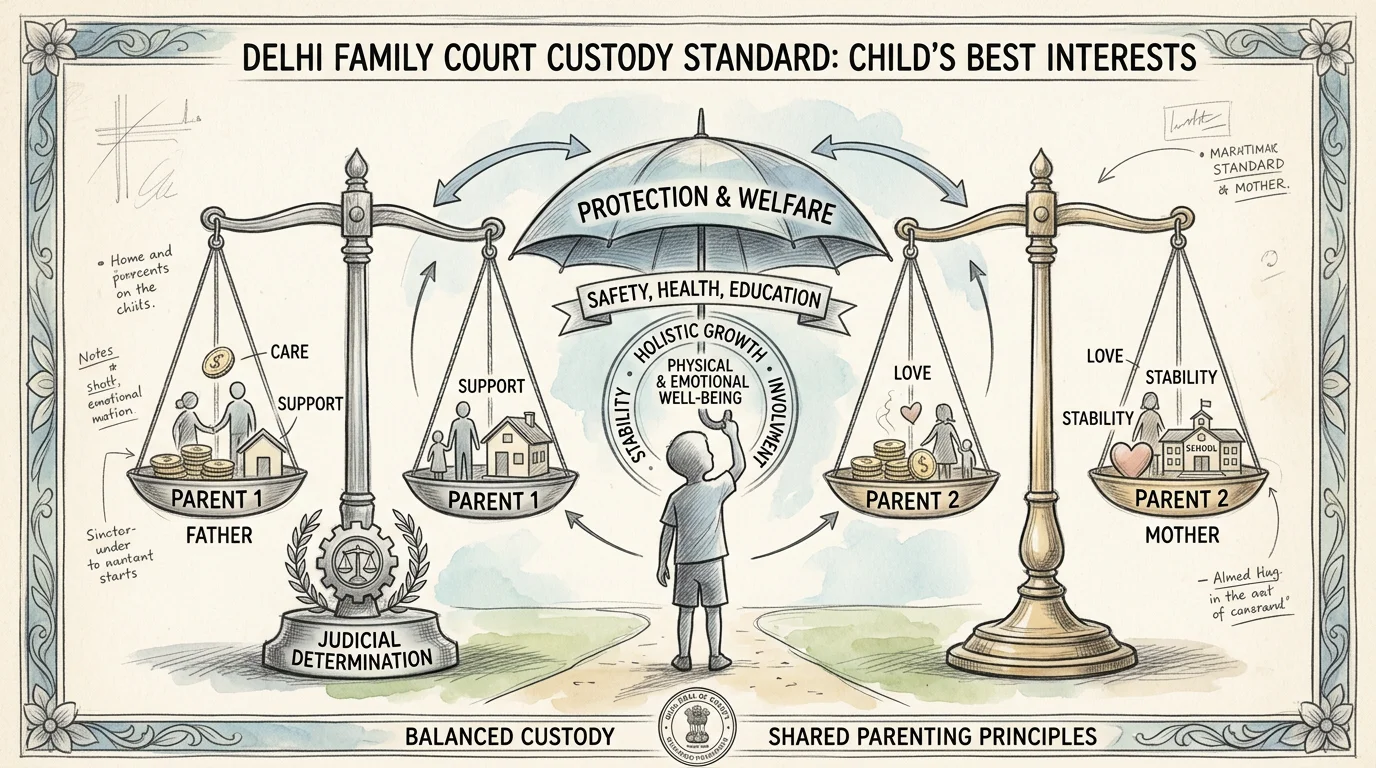
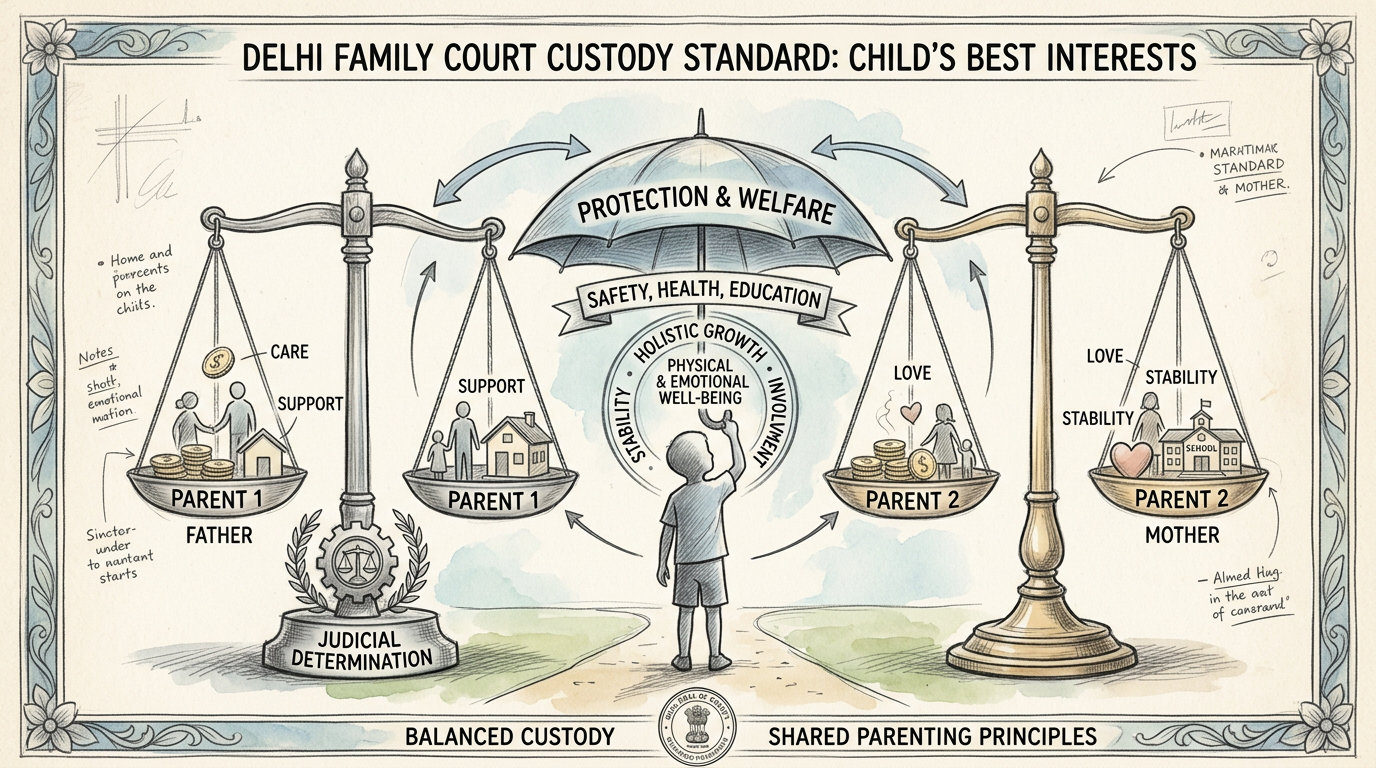
Delhi family courts decide custody based on one principle: the welfare of the child. Not the father’s rights, not the mother’s entitlement — the child’s welfare. The court looks at the child’s age, their emotional attachment to each parent, their educational needs, the moral environment each parent can provide, and whether each parent will genuinely facilitate access to the other.
Physical custody (where the child lives) and legal custody (who makes major decisions about education, health, and religion) are decided separately. A divorce lawyer in Delhi will argue for an arrangement that serves your child’s specific needs — not a standard template. Delhi courts have become more open to shared custody arrangements, especially for older children who benefit from relationships with both parents.
For NRI clients, custody becomes complicated when one parent takes the child overseas without consent. Our divorce lawyers in Delhi can seek a custody order from the Delhi family court and then use the Ministry of External Affairs’ passport powers and the Hague Convention mechanisms where applicable. The Hague Convention has strict time limits, so delay weakens the petition — time matters in cross-border custody cases.
The custody investigation process in Delhi family courts
When custody is contested, the court typically appoints a family court welfare officer or a child psychologist to prepare a custody evaluation report. This process can take several months, during which time the child’s living arrangement may be temporary. Your divorce lawyer in Delhi will prepare you for this evaluation — what the officer looks for, what questions they ask, and how to present your case in a way that centres the child’s welfare rather than your own grievances against the other parent.
The welfare officer will visit both homes, speak to the child, interview both parents, and sometimes speak to teachers or relatives. Their report carries significant weight with the judge, but it is not binding. A strong custody case built on documented evidence — school records, medical records, witness affidavits — can counter a negative welfare officer report, especially if you can show the officer missed or misunderstood relevant facts.
Maintenance: how Delhi courts calculate it
Maintenance claims run through multiple statutes simultaneously. Section 24 of the Hindu Marriage Act covers interim maintenance during proceedings. Section 25 covers permanent alimony after the decree. Section 125 CrPC operates entirely separately and can be filed even before the divorce petition. Each has its own procedure, its own quantum calculation, and its own enforcement mechanism.
Delhi family courts typically award maintenance as a percentage of the husband’s net income — usually 25 percent to 33 percent for the wife, plus separate amounts for each child. But the actual quantum depends heavily on the financial disclosures each side provides. A divorce lawyer in Delhi who prepares a thorough income affidavit — including all sources, not just salary — and cross-examines the opposing party’s disclosures will usually get a better result than one who accepts the numbers at face value.
If the paying spouse defaults on maintenance orders, enforcement is through Section 20 of the CrPC, which allows the court to issue warrants, attach property, or even initiate contempt proceedings. Delhi courts have become stricter about enforcement in recent years, but the process still requires active follow-up by your divorce lawyer in Delhi rather than simply relying on the court to police compliance.
498A and false allegations: when matrimonial disputes turn criminal
A significant number of matrimonial cases in Delhi involve parallel 498A proceedings — the provision criminalising cruelty by a husband or his relatives towards a married woman. In practice, these are sometimes filed as pressure tactics during divorce negotiations rather than based on genuine evidence of cruelty. The arrest of family members, the social stigma, and the leverage it creates in divorce negotiations make 498A a tool that is sometimes misused.
If you are facing a 498A case, our divorce lawyers in Delhi work alongside our criminal team to defend the allegations while managing the matrimonial track simultaneously. We will file for anticipatory bail under Section 438 CrPC, challenge the FIR’s maintainability, and ensure the criminal proceeding does not become a weapon in the divorce negotiation. The Supreme Court’s guidelines in Arnesh Kumar v. State of Bihar have made Delhi courts more cautious about automatic arrest in 498A cases, and we use those guidelines aggressively to protect our clients.
The intersection of criminal and matrimonial law is one of the most technically demanding areas of Delhi family court practice. A divorce lawyer in Delhi who understands both tracks — and can coordinate them without allowing one to undermine the other — provides a level of representation that a specialist in only one area cannot match.
Property and assets: what actually happens on divorce
Indian law does not divide marital property automatically on divorce — there is no statutory 50/50 split like in some jurisdictions. The Hindu Marriage Act does not have a property division provision; the court can only pass orders under Section 24 (interim maintenance) and Section 25 (permanent alimony). In practice, Delhi courts have started factoring the wife’s contribution to wealth creation into alimony calculations, which often achieves a property-division outcome through a different mechanism.
If the husband has transferred assets to relatives or hidden property before filing for divorce, a divorce lawyer in Delhi can seek attachment of those assets under the court’s inherent powers. The key is acting quickly — the longer the delay, the harder it is to trace and recover transferred assets. Our team works with forensic accountants and private investigators when asset tracing becomes necessary, particularly in high-value matrimonial disputes involving business assets, real estate portfolios, or offshore holdings.
Inter-country divorce and cross-border custody
Delhi family courts regularly handle cases involving NRI clients, foreign nationals, and marriages that took place outside India. The legal framework depends on where the marriage was solemnised, where the parties currently live, and their nationalities. A divorce lawyer in Delhi advising on cross-border matters needs to understand private international law — whether a foreign divorce decree will be recognised in India, whether a Delhi custody order can be enforced overseas, and how the Hague Convention applies when a child has been taken across borders.
The Hague Convention has strict time limits — delays weaken the petition. If you believe your child has been taken from India without your consent, a divorce lawyer in Delhi should be engaged immediately, not after you have tried to negotiate informally for months. Our team has experience with Hague Convention petitions, passport revocation through the Ministry of External Affairs, and coordinating with foreign counsel where dual jurisdiction issues arise.
Evidence: what your divorce lawyer in Delhi actually needs
Most people walk into a family court with a handful of WhatsApp screenshots and think that is enough. It is not. Delhi family courts apply the Indian Evidence Act rigorously to matrimonial proceedings, and the quality of your evidence often determines whether cruelty or desertion is proved or dismissed.
For cruelty under Section 13(1)(ia) of the Hindu Marriage Act, your divorce lawyer in Delhi needs evidence that goes beyond general unhappiness or occasional arguments. Physical cruelty is easier to document — medical records, photographs, police complaints. Mental cruelty is harder and requires a pattern of conduct: repeated insults, threats, denial of financial support, forced separation from family, or any behaviour that makes it impossible for you to continue the marriage with reasonable safety and dignity.
For desertion under Section 13(1)(ib), the key is proving that your spouse left the marital home with the intention of never returning, and that this has continued for at least two years. A single act of leaving does not constitute desertion — it must be continuous and without justification. Your divorce lawyer in Delhi will help you document the timeline through rent receipts, witness affidavits, correspondence, and any communication that shows the other party’s intention not to return.
Digital evidence has become increasingly important in Delhi family courts. WhatsApp messages, email exchanges, call records, and social media posts are all admissible under Section 65B of the Indian Evidence Act, provided you can produce a certificate authenticating the electronic record. Our divorce lawyers in Delhi understand the technical requirements of Section 65B and will ensure your digital evidence is properly authenticated before it is presented to the court.
NRIs and overseas Indians: divorce from abroad
If you are an NRI living in the UK, USA, Canada, or the Gulf, getting a divorce in Delhi while managing a job and family overseas adds a layer of complexity that most local lawyers underestimate. You cannot fly back for every hearing. You need a divorce lawyer in Delhi who can manage the case in your absence, keep you informed through video calls and email updates, and execute powers of attorney on your behalf so that your lawyer can appear and make decisions without you being physically present.
For NRI marriages solemnised in India under Indian law, the Delhi family courts retain jurisdiction regardless of where you currently live. This means you can file for divorce in Delhi even if you have not been back in years, provided the marriage was registered or solemnised under Indian law. The process typically involves granting a power of attorney to your divorce lawyer in Delhi, who then appears in court on your behalf, examines witnesses, and argues the case through to judgment.
One important consideration for NRI clients is whether a divorce obtained in India will be recognised in the country where you currently live. Different jurisdictions have different rules about recognising foreign divorce decrees, and a divorce lawyer in Delhi should coordinate with a local lawyer in your country of residence to ensure the Indian decree is enforceable where it matters most to you — particularly for property, custody, and remarriage.
Alternative dispute resolution in matrimonial cases
Delhi family courts have become increasingly proactive about sending matrimonial matters to mediation before they proceed to trial. The Delhi High Court Mediation Centre and the family court’s own mediation facility can resolve custody disputes, maintenance quantum, and property division without a formal judgment. For parties who want to preserve a working relationship — particularly when children are involved — mediation often produces better long-term outcomes than a contested judgment.
However, mediation only works when both parties are willing to engage honestly. If the other side is using mediation as a delaying tactic or has no intention of compromising, your divorce lawyer in Delhi will recognise the pattern and advise you to move for framing of issues so the court can proceed to trial. The Delhi family courts give mediation a reasonable window — typically four to six sessions — before they expect the matter to move forward.
Enforcement of divorce decrees and post-decree disputes
Getting a divorce decree is one thing. Ensuring the other party actually complies with it is another. Maintenance orders that are not paid, custody arrangements that are violated, and property division agreements that are ignored are all too common after Delhi family court judgments. A divorce lawyer in Delhi should advise you on enforcement mechanisms at the time the decree is passed, not after the other party has started ignoring the order.
For maintenance defaults, Section 20 CrPC allows the court to issue warrants, attach salary or property, and initiate contempt proceedings. For custody violations, you can seek a custody enforcement order from the family court, and in extreme cases, the court can direct police assistance to return a child who has been taken without consent. For property division, the decree can be executed as a civil court judgment — attachment of property, garnishee orders, and receiver appointment are all available.
Mental health and support during divorce proceedings
Divorce proceedings in Delhi family courts are not just a legal process — they are a psychological one. Clients who engage a divorce lawyer in Delhi are often dealing with grief, anger, guilt, and anxiety simultaneously, while trying to make rational decisions about property, custody, and financial arrangements. The best divorce lawyers in Delhi recognise this and build a support structure around the legal representation.
At Bijlani & Co, we coordinate with counsellors and mental health professionals when our clients need that support, particularly in cases involving domestic violence, child custody disputes, or high-conflict contested proceedings. We also ensure that the legal strategy accounts for the emotional dimension — for example, advising a client not to respond to provocative communications from the other side, or structuring custody arrangements that reduce conflict exposure for children. A divorce lawyer in Delhi who understands the emotional layer of matrimonial litigation provides better legal outcomes because the client is making clearer decisions.
Document checklist: what to bring to your first meeting
Walking into your first consultation with the right documents will save your divorce lawyer in Delhi significant time and will help them give you a more accurate assessment of your case. Bring the marriage certificate or proof of solemnisation, any prenuptial or postnuptial agreements, financial disclosures from both sides (salary slips, bank statements, property documents, investment records), any communication between you and your spouse that is relevant to the grounds you are relying on, and details of any previous legal proceedings between you — including police complaints, mediation attempts, or previous court filings.
If children are involved, bring their birth certificates, school records, and any existing custody arrangements or court orders. For NRI clients, bring copies of passports, visa documents, and any foreign court orders or registrations. The more complete your document set, the faster your divorce lawyer in Delhi can assess the strength of your case and recommend a strategy.
Every matrimonial matter begins with a confidential consultation. We will assess whether mutual consent is viable, what the likely outcome of a contested proceeding would be, and which strategy best protects your interests — including your relationship with your children. Then we propose a clear engagement structure with a written scope letter. You will know the fee, the timeline, and what we are committing to before we start.
Related practice areas
Matrimonial disputes often involve property division. Our civil lawyer in Delhi handles the partition track. False 498A allegations overlap with criminal defence, and our criminal lawyer in Delhi manages that. For NRI clients with cross-border assets, our corporate lawyer in Delhi advises on foreign holdings. Where digital evidence such as messages or call records is central to a matrimonial dispute, our cyber crime lawyer in Delhi assists with proper preservation and admissibility. Full coverage under one roof at Bijlani & Co.
Frequently asked questions
How long does a mutual consent divorce take in Delhi
Typically six to eighteen months, including the cooling-off period. If both parties agree and the marriage has genuinely broken down, the court may waive the cooling-off period — we file the waiver application with supporting affidavits from both spouses.
Can I get maintenance during the divorce proceedings
Yes, under Section 24 of the Hindu Marriage Act. We file maintenance applications alongside the divorce petition or as a separate interim application. The court will not expect you to litigate without financial support.
What if my spouse has hidden assets
We will investigate. Courts can attach hidden or transferred assets, and we use document discovery, cross-examination, and asset tracing to bring them into consideration. The sooner you engage, the easier it is to trace transfers before records disappear.
Can I file for divorce in Delhi if I am living abroad
If your marriage was solemnised in India under Indian law, yes — the Delhi family courts have jurisdiction regardless of where you currently reside. A divorce lawyer in Delhi at Bijlani & Co can advise on whether a foreign divorce decree will be recognised in India and help you enforce custody orders across borders.
What if my spouse has filed a 498A case against me
Engage both a divorce lawyer in Delhi and a criminal defence lawyer immediately. Our firm handles both tracks simultaneously — we will seek anticipatory bail under Section 438 CrPC, challenge the FIR’s maintainability, and ensure the criminal proceeding does not undermine your matrimonial case.
Does the wife get half the property on divorce
There is no automatic 50/50 property split on divorce under Indian law. The Hindu Marriage Act does not provide for property division — the court can only award maintenance under Sections 24 and 25. However, Delhi courts have increasingly factored the wife’s contribution to wealth creation into alimony calculations, and we push for outcomes that reflect the full financial picture of the marriage.
Speak to our divorce lawyers in Delhi
Bijlani & Co divorce lawyers in Delhi handle mutual consent, contested divorce, child custody, alimony, and matrimonial disputes. Call +91 89685 60456 or email write@bijlani.in. Office: 141, Patiala House Courts, New Delhi — 110001.
Need a lawyer in Delhi? Consult our advocate in Delhi for comprehensive legal representation. We also specialise in Divorce | Matrimonial, Cust matters.
Related Practice Areas
Explore our full range of legal services across Delhi NCR.