Cyber Crime Lawyer Delhi | FIR, IT Act & Online Fraud Defence | Bijlani & Co

Cyber Crime Lawyer Delhi | FIR, IT Act & Online Fraud Defence | Bijlani & Co

What a cyber crime lawyer in Delhi actually handles

The cyber crime lawyer’s office at Bijlani & Co does not look like a typical criminal defence practice. Most people who walk in have never been inside a courtroom before — they received a Cyber Crime Cell notice, their name came up in an IT Act investigation, or someone filed a complaint against them based on a WhatsApp message they sent. Their first question is always the same: “Am I going to be arrested?”

A cyber crime lawyer in Delhi will answer that question honestly, based on the FIR, the nature of the alleged offence, and the investigating officer’s track record. Then they will build a strategy — which might mean filing for anticipatory bail, filing a quashing petition under Section 482 CrPC, negotiating with the complainant, or preparing a full trial defence. The right approach depends on the specifics, and an experienced cyber crime lawyer in Delhi knows which track to take before the investigation consolidates.

The cases that come through our door

Social media offences are the most common category. A WhatsApp message forwarded to the wrong group, a status update that someone found offensive, a comment on a post that was interpreted as harassment — these are the scenarios that generate most cyber crime FIRs in Delhi. The Cyber Crime Cell has a dedicated social media investigation unit, and complaints are filed on the basis of a single forwarded message or a post that someone found offensive.

The defence in these cases often turns on context. Was the message sent in a private group. Was it forwarded without the sender’s knowledge. Was the complainant part of the conversation. A cyber crime lawyer in Delhi who can establish that the communication was private, consensual, or contextually different from how the prosecution describes it can secure an acquittal even where the content looks problematic on its face.

Advance-fee fraud is the second most common category. Fake job offers, bogus loan schemes, fraudulent investment platforms — these generate a huge volume of FIRs in Delhi. The person who ends up accused is often not the mastermind but someone whose bank account was used as a mule. A cyber crime lawyer in Delhi handling these cases will focus on the knowledge element: did the accused know the scheme was fraudulent, or were they a participant without that knowledge.

Many mule account holders were promised a commission for letting their account be used, without understanding the scheme’s nature. A cyber crime lawyer in Delhi can often secure discharge by demonstrating lack of fraudulent intent — the accused did not design the scheme, did not control the transactions, and did not benefit meaningfully from the proceeds.

Identity theft and impersonation cases under Section 66C and Section 66D IT Act are growing rapidly. Fake profiles on dating apps, impersonation on social media, misuse of Aadhaar or PAN details — these offences carry significant penalties and often involve cross-jurisdictional elements that complicate the defence. A cyber crime lawyer in Delhi needs to understand how digital evidence is collected, preserved, and presented in court.

Data breach and privacy matters are the newest category. The Digital Personal Data Protection Act, 2023 has created new legal obligations and new enforcement mechanisms. A cyber crime lawyer in Delhi advising corporate clients on data breach response needs to navigate the overlap between the IT Act and the DPDP Act — each has its own notification requirements, timelines, and penalty structures.

What happens after you get a Cyber Crime Cell notice

The notice arrives — usually under Section 91 CrPC or Section 160 CrPC — and panic sets in. Most people’s instinct is to explain themselves at the police station. That instinct is almost always wrong. A cyber crime lawyer in Delhi will review the FIR first, understand what the investigation is targeting, and then advise whether appearing without a lawyer is safe or whether it will make things worse.

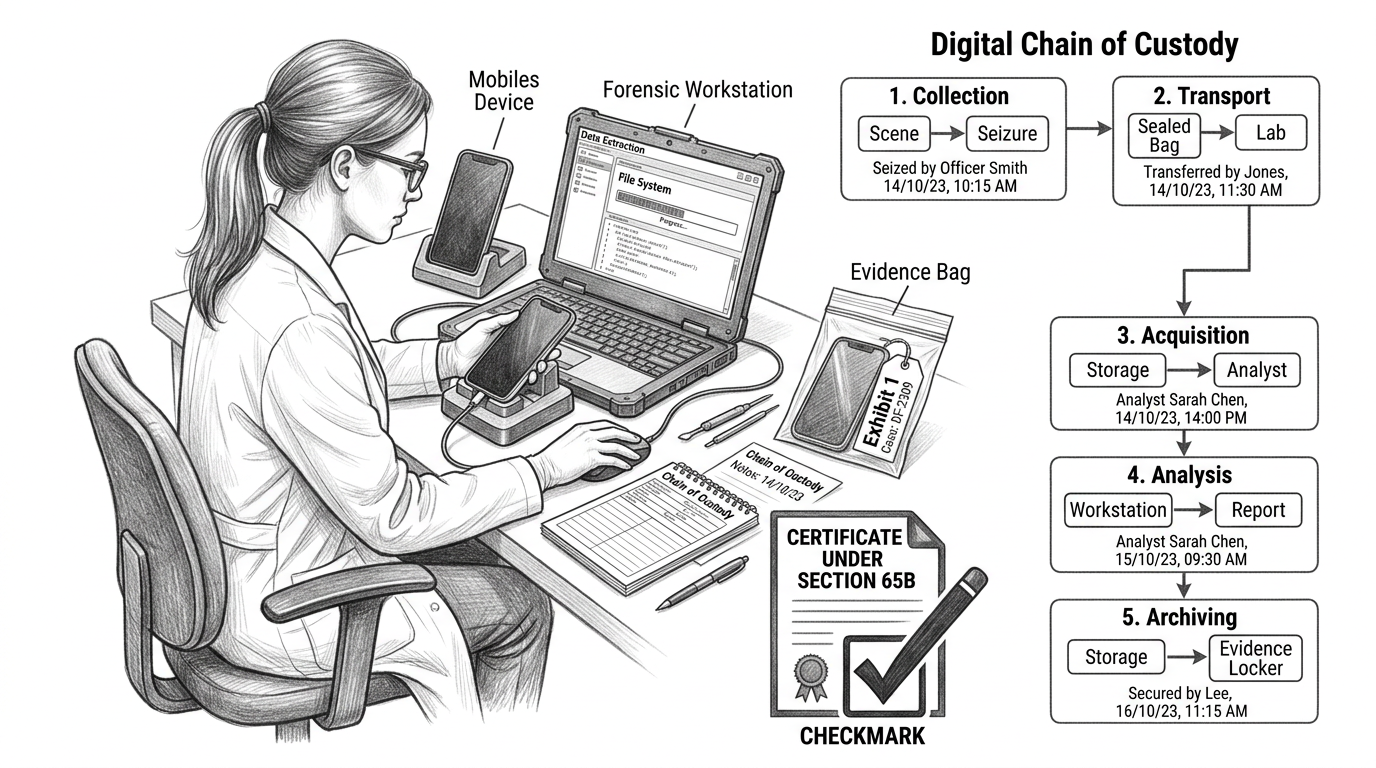
The Delhi Police Cyber Crime Cell operates from specialised units with forensic capabilities — they can retrieve deleted data, trace IP addresses through ISPs, and analyse devices. But their investigation is not infallible. A cyber crime lawyer in Delhi will scrutinise how evidence was collected, whether the chain of custody is intact, whether the Section 65B certificate is properly executed, and whether the IP address evidence actually connects your client to the alleged offence.

Challenging digital evidence: what actually works

Electronic evidence in Indian courts is governed by Section 65B of the Indian Evidence Act. The certificate under Section 65B(4) is mandatory — without it, the evidence is inadmissible. In practice, many Delhi Cyber Crime Cell cases have defective certificates: produced late, not properly attested, or missing key details about the device’s condition at the time of seizure. A cyber crime lawyer in Delhi who spots these gaps early can have the entire digital evidence excluded.

IP address evidence is the other common weak point. An IP address does not uniquely identify a person — it can be dynamic, shared across a household, routed through a VPN, or assigned to someone else at the time of the alleged offence. The Cyber Crime Cell often obtains subscriber data from ISPs without following the proper authorisation procedure, and a cyber crime lawyer in Delhi can challenge the admissibility of that subscriber information at the threshold stage.

WhatsApp and social media: the most common cyber crime scenario

The majority of cyber crime FIRs registered in Delhi now involve WhatsApp messages, Instagram posts, or Facebook content. The Cyber Crime Cell has a dedicated social media investigation unit, and complaints are filed on the basis of a single forwarded message or a post that someone found offensive.

The defence in these cases often turns on context. Was the message sent in a private group. Was it forwarded without the sender’s knowledge. Was the complainant part of the conversation. A cyber crime lawyer in Delhi who can establish that the communication was private, consensual, or contextually different from how the prosecution describes it can secure an acquittal even where the content looks problematic on its face.

WhatsApp’s end-to-end encryption is often raised by clients as a defence — “how can they prove what I sent.” The answer is more nuanced than most people expect. While WhatsApp messages are encrypted in transit, the device itself may contain cached messages, backups, or metadata that can be extracted. A cyber crime lawyer in Delhi will assess what evidence the prosecution actually has, how it was obtained, and whether the forensic process was legally sound — rather than relying on encryption as an automatic defence.

Advance-fee fraud: defending the accused who did not know

Advance-fee fraud — fake job offers, bogus loan schemes, fraudulent investment platforms — generates a huge volume of FIRs in Delhi. The person who ends up accused is often not the mastermind but someone whose bank account was used as a mule. A cyber crime lawyer in Delhi handling these cases will focus on the knowledge element: did the accused know the scheme was fraudulent, or were they a participant without that knowledge.

Many mule account holders were promised a commission for letting their account be used, without understanding the scheme’s nature. A cyber crime lawyer in Delhi can often secure discharge by demonstrating lack of fraudulent intent — the accused did not design the scheme, did not control the transactions, and did not benefit meaningfully from the proceeds.

The Enforcement Directorate sometimes gets involved in larger advance-fee fraud cases under PMLA, particularly where the fraud involves significant financial flows. When PMLA is involved, the stakes are higher — the ED can attach assets, freeze bank accounts, and the burden of proof shifts to the accused once a prima facie case is made. A cyber crime lawyer in Delhi coordinating with a criminal lawyer who understands PMLA procedure is essential in these cases.

DPDP Act: the new compliance frontier

The Digital Personal Data Protection Act, 2023 has created a new layer of legal risk for companies handling personal data. The Act imposes obligations around consent, data minimisation, breach notification, and data principal rights. A cyber crime lawyer in Delhi advising corporate clients will typically start with a readiness review — mapping data flows, identifying consent mechanism gaps, and stress-testing the company’s breach response capability.

When a breach occurs, the question is whether to notify the Data Protection Board, how to handle affected individuals, and whether the breach also triggers IT Act obligations. The overlap between the DPDP Act and the IT Act is still evolving, and a cyber crime lawyer in Delhi who is actively tracking case law developments can advise on the most defensible position — which is not always the most obvious one.

How we work

Urgent matters get urgent responses. When a client receives a Cyber Crime Cell notice or an IT Act FIR, they need guidance immediately — not a delayed response from a call centre. Our cyber crime lawyers in Delhi are available for same-day consultations, and we prioritise bail applications and quashing petitions for clients who are at risk of arrest.

For corporate clients, we propose ongoing ongoing advisory arrangements that include regular compliance reviews, breach response protocols, and advisory support for data governance. The DPDP Act is still in its early enforcement phase, and the penalties are significant — proactive compliance is far cheaper than enforcement response.

Data breach response: the first 72 hours

Under the Digital Personal Data Protection Act, 2023, a data fiduciary that suffers a personal data breach must notify the Data Protection Board and, in many cases, the affected individuals, within a prescribed timeframe. A cyber crime lawyer in Delhi advising a company through a breach focuses first on containment, working with the technical team to establish what data was accessed, whether the breach is ongoing, and what systems need to be isolated.

The notification obligation under the DPDP Act is separate from any criminal complaint the company may need to file under the IT Act if the breach resulted from unauthorised access or hacking. A cyber crime lawyer in Delhi handling breach response typically manages both tracks simultaneously: the regulatory notification process, which is compliance-driven and time-sensitive, and the criminal complaint against the perpetrator, which follows a different procedural timeline through the Cyber Crime Cell.

Companies that delay legal involvement after discovering a breach often compound the problem. Internal communications about the breach, if not properly privileged, can become discoverable in subsequent litigation or regulatory proceedings. A cyber crime lawyer in Delhi engaged early can help structure the internal investigation to preserve privilege while still allowing the technical response to proceed without delay.

Identity theft and financial fraud online

Online financial fraud in Delhi typically falls into a few recurring patterns: phishing that leads to unauthorised bank transfers, SIM swap fraud that allows an attacker to intercept OTPs, and fake investment schemes that solicit funds through social media or messaging apps. A cyber crime lawyer in Delhi handling these cases works closely with the victim to preserve transaction records, bank statements, and communication logs before they are lost or overwritten.

The first step after discovering financial fraud is usually filing a complaint on the National Cyber Crime Reporting Portal, followed by a formal FIR at the jurisdictional Cyber Crime Cell. Time matters here more than in most other cyber offences, because banks can sometimes freeze the fraudulent transaction if reported within the golden hour, typically the first few hours after the transaction. A cyber crime lawyer in Delhi will guide a victim through this reporting process while simultaneously preparing for the possibility that recovery of funds may take considerably longer through the courts.

Where the accused is identified, prosecution proceeds under Section 66C and 66D of the IT Act for identity theft and cheating by personation using a computer resource, often alongside Section 420 of the Indian Penal Code for cheating. A cyber crime lawyer in Delhi representing either the victim seeking prosecution or the accused disputing involvement needs to carefully examine the digital trail, including IP logs, device fingerprints, and the chain of custody for any seized electronic evidence.

Defending against wrongful cyber crime accusations

Not every cyber crime complaint is well-founded. A common scenario involves a shared device, a compromised account, or a case of mistaken IP attribution, where the person named in the FIR genuinely did not commit the alleged offence. A cyber crime lawyer in Delhi defending such a case focuses on the technical gaps in the prosecution’s evidence: whether the IP address was correctly attributed, whether the device seized actually belonged to the accused, and whether the digital forensic report followed proper chain-of-custody protocols under Section 65B of the Evidence Act.

Section 65B compliance is frequently the deciding factor in cyber crime trials. Electronic evidence that is not accompanied by a proper certificate under Section 65B can be challenged as inadmissible, regardless of how incriminating it appears. A cyber crime lawyer in Delhi defending a client will scrutinise every piece of digital evidence for this procedural requirement before the trial even reaches the merits.

Cyberstalking, doxxing, and online harassment

Online harassment cases in Delhi have grown more complex as perpetrators use multiple platforms, fake accounts, and cross-border services to evade identification. A cyber crime lawyer in Delhi handling a stalking or doxxing complaint under Section 354D of the Indian Penal Code, read with Section 66E of the IT Act for violation of privacy, first focuses on preserving evidence before the perpetrator can delete posts or deactivate accounts.

Screenshots alone are rarely sufficient in these cases. A cyber crime lawyer in Delhi will typically recommend a more formal preservation process: notarised screenshots with timestamps, platform-issued content reports, and where possible, a formal request to the platform under Indian law for account information. Many social media platforms have a legal request process for Indian law enforcement, and a cyber crime lawyer in Delhi assisting the police with such a request can meaningfully speed up identification of an anonymous harasser.

Doxxing, the publication of private information such as home address, phone number, or workplace with intent to harass, often accompanies stalking cases and can independently support both criminal charges and a civil claim for damages. A cyber crime lawyer in Delhi advising a doxxing victim will usually pursue both the criminal complaint and a parallel request for a protective order restraining further publication of the victim’s personal information.

Cyber crime jurisdiction: where to file, and why it matters

Determining the correct jurisdiction for a cyber crime FIR is more complicated than in a physical offence, since the victim, the accused, and the servers involved may all be in different states or even different countries. Under Section 4 of the IT Act read with Section 179 of the CrPC, a complaint can generally be filed at the place where the offence occurred, which for online fraud usually includes the victim’s location, since that is where the financial loss was suffered. A cyber crime lawyer in Delhi filing a complaint on behalf of a victim will typically file at the Delhi Cyber Crime Cell nearest the victim’s residence, rather than trying to locate the accused first.

Jurisdictional disputes sometimes arise when the accused challenges the FIR on the ground that the investigating agency lacks territorial jurisdiction. A cyber crime lawyer in Delhi defending against such a challenge relies on the settled position that cyber offences are treated as continuing offences occurring wherever any part of the transaction, including the victim’s loss, took place, which gives Delhi courts jurisdiction in most cases involving Delhi-based victims regardless of where the accused is physically located.

Cross-border cases add a further layer of complexity when the perpetrator or the servers are located outside India. Mutual Legal Assistance Treaty requests and Interpol coordination become relevant, and a cyber crime lawyer in Delhi handling such matters works alongside the investigating agency to route requests for foreign platform data through the correct diplomatic and legal channels, a process that can take considerably longer than a domestic investigation.

Related practice areas

Cyber crime matters sometimes overlap with white-collar offences. If your IT Act case involves financial fraud, our criminal lawyer in Delhi has experience with PMLA and PC Act defence. For data protection governance in a corporate context, our corporate lawyer in Delhi handles the compliance framework alongside our cyber crime practice. Where a cyber matter involves a civil recovery claim, such as reversing an unauthorised transaction, our civil lawyer in Delhi handles the recovery suit. Cyber harassment cases arising from matrimonial disputes are coordinated with our divorce lawyer in Delhi.