
Mutual consent divorce is the fastest and most amicable way to end a marriage in Ghaziabad. Under Section 13B of the Hindu Marriage Act, 1955, both spouses can file a joint petition for divorce by mutual consent, provided they have been living separately for at least one year. This guide explains the procedure, documents required, and timelines for mutual consent divorce in Ghaziabad Family Court.
Eligibility for Mutual Consent Divorce in Ghaziabad
To file for mutual consent divorce in Ghaziabad, the following conditions must be met:
- Both spouses must consent to the divorce voluntarily and without coercion
- The couple must have been living separately for at least one year before filing the petition
- The marriage must have been solemnised under the Hindu Marriage Act, 1955, or the Special Marriage Act, 1954
- The couple must have settled all issues relating to alimony, maintenance, child custody, and property division, or must be willing to settle them through a memorandum of understanding
If both parties agree on all terms, the process is significantly faster than a contested divorce. Our divorce lawyers in Ghaziabad have successfully resolved hundreds of mutual consent divorce cases in Ghaziabad Family Court.
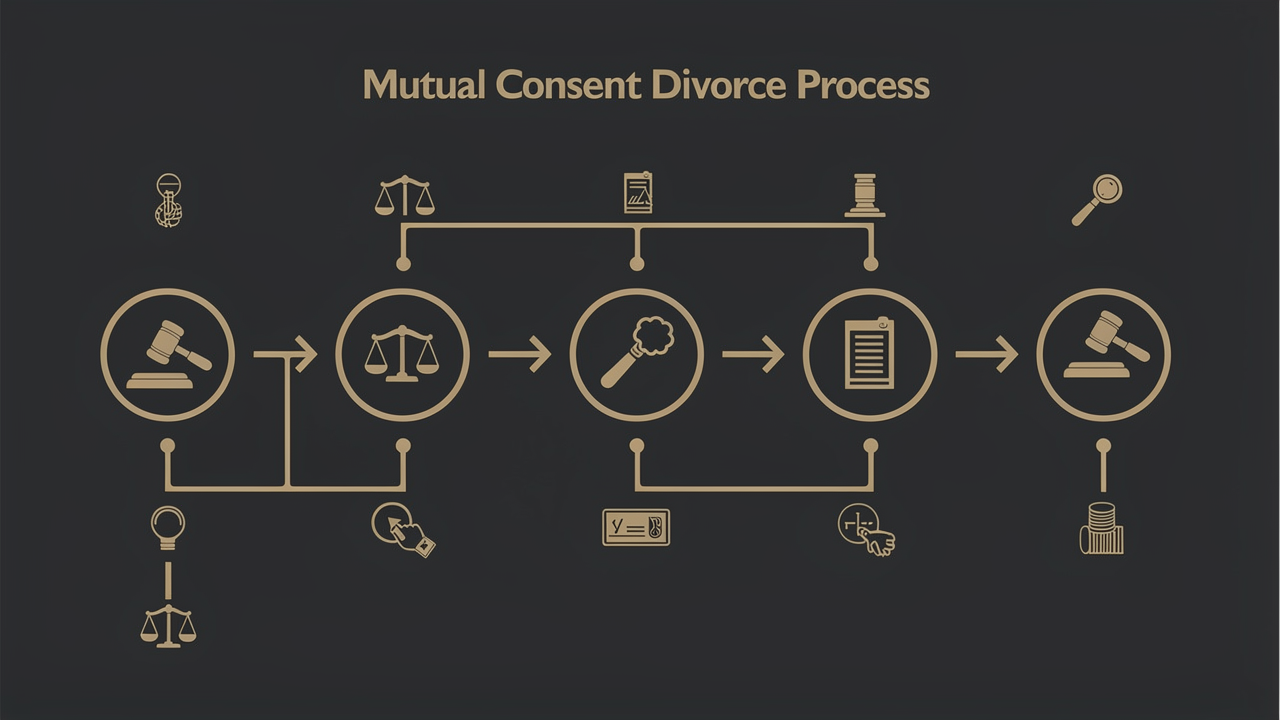
Mutual Consent Divorce Procedure in Ghaziabad
Step 1: Draft the Joint Petition
The first motion involves filing a joint petition under Section 13B of the Hindu Marriage Act. The petition should state that the couple has been living separately for at least one year, that they have not been able to live together, and that they mutually agree to dissolve the marriage. The petition must also include a memorandum of understanding (MOU) covering alimony, maintenance, child custody, and property division.
Step 2: First Motion Hearing
After the petition is filed, the court records the statements of both parties on oath. The court verifies that the consent is genuine and voluntary, and that the MOU is fair and reasonable. The first motion is then concluded, and the court orders a waiting period of 6 months before the second motion.
Step 3: Second Motion (After 6 Months)
After the mandatory 6-month cooling-off period, the couple appears for the second motion. If both parties still confirm their consent to the divorce, the court grants the decree of divorce. The 6-month waiting period can be waived if the court is satisfied that the couple has been living separately for more than the statutory period and there is no possibility of reconciliation.
Step 4: Divorce Decree
Once the second motion is concluded and the court is satisfied with the consent of both parties, a decree of divorce is granted. The decree dissolves the marriage, and both parties are free to remarry after the appeal period (30 days from the date of the decree).
Documents Required for Mutual Consent Divorce in Ghaziabad
- Marriage certificate or proof of solemnisation (wedding invitation, photographs, etc.)
- Aadhaar card and PAN card of both spouses
- Address proof of both spouses (current and at the time of marriage)
- Passport-size photographs of both spouses
- Evidence of living separately for at least one year (affidavit, separate residence proof)
- Memorandum of Understanding (MOU) covering alimony, maintenance, child custody, and property division
- Income proof of both spouses (salary slips, ITR, bank statements)
- Details of children (if any), date of birth, current custody arrangement, education expenses
Alimony and Maintenance in Mutual Consent Divorce
Alimony (maintenance) is one of the most important aspects of a mutual consent divorce. The amount depends on several factors:
- The earning capacity and financial status of the husband
- The needs and financial status of the wife
- The duration of the marriage
- The lifestyle the wife was accustomed to during the marriage
- Any sacrifices made by the wife for the family (e.g., giving up a career)
Our maintenance lawyers in Ghaziabad can help you negotiate a fair alimony arrangement that protects your financial interests.
Child Custody in Mutual Consent Divorce
Child custody is governed by the personal law applicable to the couple, typically the Hindu Minority and Guardianship Act, 1956, or the Guardians and Wards Act, 1890. The court’s primary concern is the welfare of the child. Couples can agree on joint custody, sole custody with visitation rights, or any other arrangement that serves the child’s best interests.
Our child custody lawyers in Ghaziabad can help you draft a custody arrangement that protects your relationship with your children.
Jurisdiction and Venue for Mutual Consent Divorce
To file for mutual consent divorce in Ghaziabad, the Ghaziabad Family Court must have jurisdiction. Jurisdiction is determined by the place where the marriage was solemnised, where the parties last resided together, or where the respondent (the other spouse) currently resides. If you married in Ghaziabad or last lived together here, the Ghaziabad Family Court has jurisdiction to hear your case.
The Family Court in Ghaziabad is located at the District Courts Complex, near the Ghaziabad Railway Station. The court operates on weekdays and follows the roster system for family law cases. Filing fees for divorce petitions in Ghaziabad Family Court are nominal, typically ranging from ₹200 to ₹500 depending on the type of petition and whether it includes ancillary claims like maintenance or custody.
Grounds for Mutual Consent Divorce vs. Contested Divorce
While mutual consent divorce under Section 13B of the Hindu Marriage Act is the preferred route when both parties agree, it is important to understand the distinction from a contested divorce. In a contested divorce, one spouse files the petition unilaterally on grounds such as:
- Cruelty: Physical or mental cruelty that makes it impossible to live together
- Desertion: Abandonment by the spouse for at least 2 years without reasonable cause
- Adultery: Voluntary sexual intercourse with a person outside the marriage
- Conversion: Voluntary conversion to another religion
- Mental disorder: Incurable mental disorder or unsound mind
A contested divorce typically takes 3–5 years or more, compared to 6–12 months for mutual consent divorce. Our divorce lawyers in Ghaziabad can advise on whether mutual consent is viable in your situation or if a contested petition is more appropriate.
Waiver of the Six-Month Cooling-Off Period
Under Section 13B(2) of the Hindu Marriage Act, there is a mandatory waiting period of six months between the first and second motion. However, the Supreme Court of India has held that this period can be waived in exceptional circumstances. The Allahabad High Court and Ghaziabad Family Court have applied this principle in cases where:
- The marriage has irretrievably broken down with no chance of reconciliation
- The parties have been living separately for well over one year
- Waiving the period will not cause any prejudice to either party
- There are no minor children whose custody arrangements need further negotiation
If you believe your case qualifies for a waiver, our divorce lawyers in Ghaziabad can file a separate application before the Ghaziabad Family Court requesting the waiver, supported by affidavits from both parties.
Property Division and Settlement in Mutual Consent Divorce
Property division is a critical aspect of any divorce. In mutual consent divorces, the parties negotiate and settle property division through the Memorandum of Understanding (MOU). Key considerations include:
- Stridhan and gifts: All gifts received by the wife during the marriage (jewellery, cash, property) are her absolute property and must be returned in full
- Matrimonial property: Property acquired during the marriage is typically divided equally, unless otherwise agreed in the MOU
- Ancestral property: The wife’s claim to ancestral property depends on applicable personal law and the specific property type
- Bank accounts and investments: Joint accounts, fixed deposits, and mutual fund investments should be disclosed and divided as per the MOU
- Retirement benefits: Gratuity, provident fund, and pension benefits accumulated during the marriage may be subject to division
A well-drafted MOU that covers all financial aspects prevents future disputes. Our divorce lawyers in Ghaziabad ensure that the MOU is comprehensive, fair, and legally enforceable.
International Marriages and Divorce in Ghaziabad
If you married abroad or have a foreign spouse, mutual consent divorce in Ghaziabad is still possible under the Foreign Marriage Act, 1969 or the Special Marriage Act, 1954. The process is similar to a domestic mutual consent divorce, but additional documentation is required:
- Marriage certificate issued by the foreign country (apostilled or attested by the Indian consulate)
- Proof of residence in India (if applicable)
- Passport copies of both parties
- Proof that the marriage is valid under Indian law
If one spouse is a foreign national residing outside India, the divorce petition can still be filed in Ghaziabad if the marriage was registered in India or if the parties have resided in India after marriage. Our divorce lawyers in Ghaziabad can advise on international divorce matters.
Frequently Asked Questions
How long does mutual consent divorce take in Ghaziabad?
The minimum waiting period for mutual consent divorce in Ghaziabad is 6 months — this is the mandatory cooling-off period between the First Motion and Second Motion. However, in practice, it takes 6-9 months if both parties cooperate. If the parties waive the 6-month cooling-off period with court approval (Section 13B(2)), the divorce can be completed in 2-3 months. Cases involving disputes over alimony or child custody take longer — typically 12-18 months.
Is mutual consent divorce possible without a lawyer?
Technically yes, but highly impractical. Mutual consent divorce requires drafting a joint petition, appearing before the court for two motions, and managing the cooling-off period. Any mistake in the petition can result in rejection. A lawyer ensures the petition is drafted correctly, represents you in court, and handles any objections that arise. Our divorce lawyers in Ghaziabad charge reasonable fees for mutual consent divorce cases and can complete the process efficiently.
Can a mutual consent divorce be reversed?
Mutual consent divorce can only be reversed before the Second Motion — after the Second Motion is passed and the decree is granted, the divorce is final. If one party withdraws consent between the First and Second Motion, the other party cannot force the divorce — the case is dismissed. However, the aggrieved party can file a fresh petition for contested divorce on valid grounds such as cruelty, desertion, or adultery.
How long does mutual consent divorce take in Ghaziabad Family Court?
The entire process takes approximately 6–12 months, including the mandatory 6-month cooling-off period. If the court waives the cooling-off period, the divorce can be granted in as little as 3–4 months.
Can mutual consent divorce be filed if one spouse does not agree?
No. Mutual consent divorce requires agreement from both spouses. If one spouse does not consent, the other must file a contested divorce on grounds such as cruelty, desertion, or adultery.
Is the 6-month waiting period mandatory?
Yes, under Section 13B(2) of the Hindu Marriage Act, the court must wait at least 6 months between the first and second motion. However, the Supreme Court has held that this period can be waived in exceptional circumstances.
Can the MOU (memorandum of understanding) be modified after the divorce?
The MOU can be modified only by mutual agreement of both parties. If one party wants to modify the terms after the divorce, they must file a separate application in court.
What if my spouse withdraws consent after the first motion?
If either spouse withdraws consent at any time before the second motion, the mutual consent divorce petition becomes void. The aggrieved spouse can then file a contested divorce.
Divorce Legal Services in Ghaziabad
Mutual consent divorce is the most amicable way to end a marriage, but it requires careful drafting of the MOU and proper legal representation in court. Our divorce lawyers in Ghaziabad can help you navigate the entire process smoothly. For comprehensive family law support, consult an advocate in Ghaziabad today.
