

Cheque bounce, or dishonour of cheque, is one of the most common financial disputes in India. Under Section 138 of the Negotiable Instruments Act, 1881, issuing a cheque that bounces due to insufficient funds or other reasons is a criminal offence punishable with imprisonment up to two years and/or a fine of twice the cheque amount. If you have received a bounced cheque from someone in Ghaziabad, this guide explains the legal process for filing a complaint and recovering your money.
What Constitutes a Cheque Bounce Under Section 138?
A cheque bounces under Section 138 of the NI Act when:
- The cheque is issued to discharge a debt or liability (past or present)
- The cheque is presented to the bank within its validity period (3 months from the date of issue)
- The bank returns the cheque unpaid due to insufficient funds, account closed, or stop payment
- The payee sends a legal notice to the drawer within 30 days of receiving the return memo from the bank
- The drawer fails to pay the amount within 15 days of receiving the notice
Steps to Take When a Cheque Bounces in Ghaziabad
Step 1: Obtain the Bank Return Memo
When a cheque bounces, the bank provides a return memo stating the reason for dishonour, insufficient funds, account closed, stop payment, etc. This memo is the primary evidence in a cheque bounce case. Keep it safe.
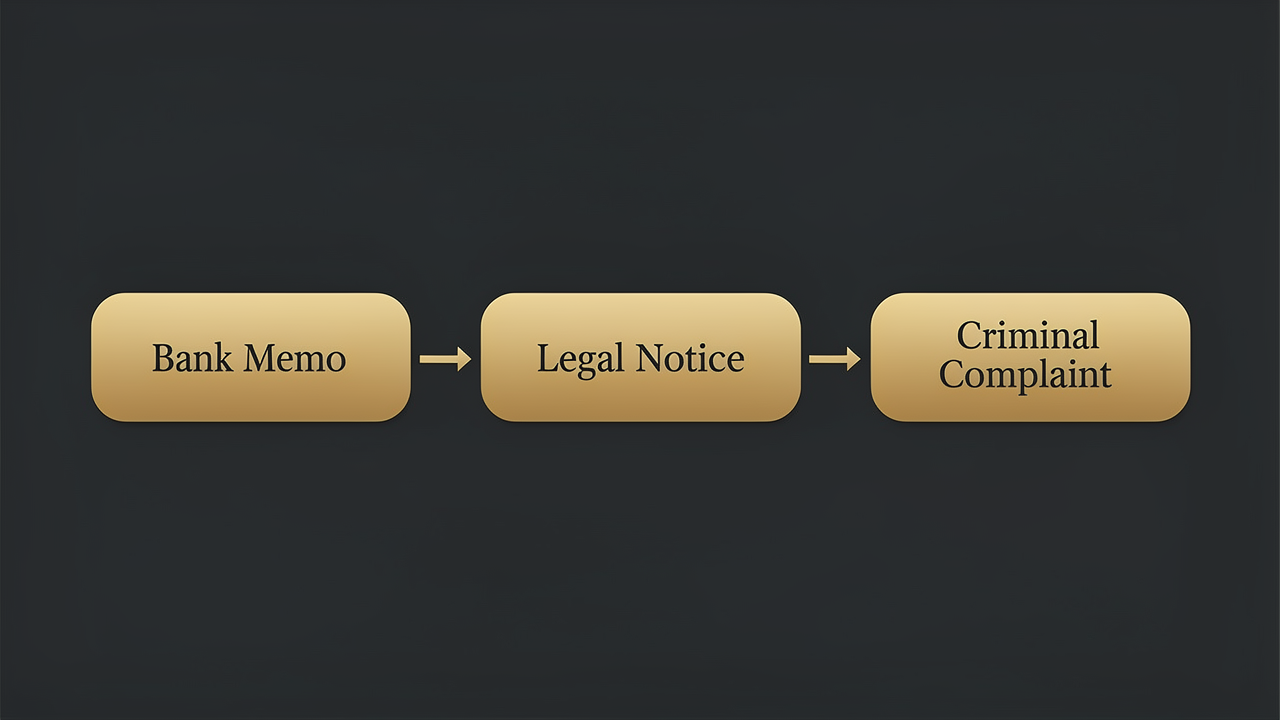
Step 2: Send a Legal Notice
Within 30 days of receiving the return memo, send a legal notice to the drawer (the person who issued the cheque) through a registered post. The notice should demand payment of the cheque amount within 15 days. Keep the proof of delivery (postal receipt).
Step 3: File a Criminal Complaint
If the drawer fails to pay within 15 days of receiving the notice, you can file a criminal complaint under Section 138 of the NI Act before the Judicial Magistrate First Class (JMFC) court in Ghaziabad. The complaint should include:
- The bounced cheque
- Bank return memo
- Copy of the legal notice and proof of delivery
- Affidavit
- List of witnesses
Step 4: Court Proceedings
The court issues summons to the drawer. If the drawer fails to appear, the court may issue a warrant. If the drawer pleads guilty, the court can pass a sentence immediately. If the drawer pleads not guilty, the trial proceeds with evidence from both sides.
Defence Available to the Drawer
The drawer (person who issued the cheque) can defend against a Section 138 complaint on several grounds:
- The cheque was not issued for a debt or liability: Section 138 applies only to cheques issued to discharge a debt. If the cheque was issued as a gift or for a transaction that was never completed, Section 138 may not apply
- The cheque was lost or stolen: If the drawer can prove the cheque was lost or stolen and misused
- Stop payment was due to a genuine dispute: If the drawer stopped payment because of a genuine dispute over the underlying transaction, this can be a defence
- The notice was not received: If the drawer can prove they did not receive the legal notice
Our cheque bounce lawyers in Ghaziabad specialise in both filing and defending cheque bounce cases.
Time Limit for Filing a Cheque Bounce Complaint
The complaint under Section 138 must be filed within 3 months from the date on which the 15-day notice period expires. Missing this deadline can make your complaint time-barred. File promptly.
Compoundability of Cheque Bounce Cases
Cheque bounce cases under Section 138 are compoundable, meaning the parties can settle the dispute and compromise the case at any stage. If the drawer pays the cheque amount, the complainant can file an application to compound the case, and the court will close the proceedings.
Timeline for Filing a Section 138 Complaint in Ghaziabad
The timeline for filing a cheque bounce complaint under Section 138 of the Negotiable Instruments Act, 1881 is strict and must be followed precisely. The complaint must be filed within 3 months of the date on which the cause of action arose (typically the date of dishonour of the cheque). Failure to file within this period makes the complaint time-barred.
The legal process in Ghaziabad typically follows this timeline:
- Day 0: Cheque presented to bank, dishonoured due to insufficient funds or other reasons
- Within 15 days: Send a legal notice (demand notice) to the drawer by registered post with AD and ordinary post
- Within 15 days of receiving notice: The drawer must pay the amount. If not paid, file the complaint
- Filing complaint: File before the Judicial Magistrate First Class (JMFC) court in Ghaziabad within 3 months of dishonour
- Summons to accused: The court issues summons to the drawer. If they do not appear, a non-bailable warrant may be issued
- Trial: The trial proceeds with evidence from both sides. Typical duration is 1–3 years in Ghaziabad courts
In Ghaziabad, Section 138 complaints are filed before the Judicial Magistrate Courts located at the District Courts Complex. The court fees are nominal (typically ₹100–₹200), making it a cost-effective remedy for recovering money.
Defences Available in a Section 138 Case
If you have been served with a notice under Section 138 in Ghaziabad, the following defences may be available:
- Cheque issued as security: If the cheque was issued as a security deposit or advance and not for discharge of an existing debt, Section 138 may not apply
- Stop payment instructions: If the stop payment was issued due to a genuine dispute about the quality of goods or services, the drawer may have a defence
- Cheque lost or stolen: If the cheque was lost or stolen before being presented, the drawer is not liable
- Insufficient notice: If the legal notice was not properly served or was not in the prescribed format
- Discharge of debt not proven: If the payee cannot prove that the cheque was issued for the discharge of an existing debt or liability
- Fresh cause of action: If a fresh cheque was issued for the same old debt, the limitation period may restart from the date of the new cheque
Our criminal lawyers in Ghaziabad specialise in defending cheque bounce cases and can identify the strongest defence strategy based on the facts of your case.
Section 138 Cheque Bounce as a Compoundable Offence
While Section 138 was previously non-compoundable, the Supreme Court has held that it can be compounded (settled) between the parties with the court’s permission. This means that if the drawer pays the cheque amount and the payee agrees to withdraw the complaint, the court can allow the compounding.
In Ghaziabad, compounding of cheque bounce cases is a common practice. The process involves:
- Both parties appearing before the court
- The drawer paying the full cheque amount along with interest and costs
- The payee filing a compromise petition (affidavit) stating that the dispute has been settled
- The court allowing the compounding and acquitting the accused
Compounding has the advantage of clearing the accused’s criminal record. Without compounding, a conviction under Section 138 can lead to imprisonment up to 2 years and/or a fine of twice the cheque amount, and it appears on the accused’s criminal record.
Compensation Under Section 357 CrPC (Now BNS)
The court can also award compensation to the victim under the provisions of the BNS (formerly Section 357 CrPC). This compensation is in addition to the fine imposed under Section 138. The court considers the following factors when awarding compensation:
- The amount of the cheque
- Interest accrued from the date of dishonour
- The financial loss suffered by the payee
- Any legal expenses incurred in pursuing the case
Our lawyers in Ghaziabad ensure that the court awards adequate compensation to our clients who have been victims of cheque dishonour.
Cheque Bounce: Complete Timeline and Compounding Guide
Understanding the exact timeline and the option of compounding (settlement) gives you strategic control over the case:
Complete timeline from cheque bounce to conviction:
Day 0: Cheque is presented to bank and returned unpaid. Bank issues a return memo. Day 15: You send a legal notice to the drawer demanding payment within 15 days. Day 30: If payment is not made within 15 days of the notice, you can file a criminal complaint under Section 138. Day 30-60: Court issues summons to the accused. Day 60-90: Accused appears and applies for bail (normally granted). Month 6-18: Trial proceedings — evidence, witness examination, arguments. Month 18-24: Verdict and sentencing.
Compounding the cheque bounce case:
Section 138 is compoundable — you can settle the case at any stage before the final order. Compounding means the drawer pays the cheque amount plus any agreed compensation, and you file an application to close the case. Courts actively encourage compounding as it reduces judicial burden. Our cheque bounce lawyers in Ghaziabad negotiate settlements and file compounding applications efficiently.
Limitation period:
The complaint must be filed within 3 months from the date the cheque bounce memo is issued by the bank. If you miss this window, the complaint is time-barred. However, if you have a valid reason for the delay, the court may condone the delay.
Related Legal Guides
Need Expert Legal Representation in Ghaziabad?
Advocate Nilesh Bijlani and the team at Bijlani & Co. handle all practice areas across Delhi NCR courts.
Consult an Advocate in GhaziabadFrequently Asked Questions
Related Legal Guides
Need Expert Legal Representation in Ghaziabad?
Advocate Nilesh Bijlani and the team at Bijlani & Co. handle all practice areas across Delhi NCR courts.
Consult an Advocate in GhaziabadCan a cheque bounce case be compounded in Ghaziabad?
Yes, Section 138 of the Negotiable Instruments Act is compoundable — the complainant and the accused can settle the case at any stage before the final order. Compoundability means that once the drawer pays the cheque amount plus any agreed compensation, the complainant can file an application to close the case. Courts encourage compounding as it reduces the burden on the judicial system and saves time for both parties. Our cheque bounce lawyers in Ghaziabad can help you negotiate a settlement and file the compounding application.
What is the validity of a bounced cheque in India?
A cheque is valid for 3 months from the date of issue. If the cheque is presented within this 3-month period and is returned unpaid, the payee can file a complaint under Section 138. If the cheque has expired (more than 3 months old), it cannot be presented for payment, but if it was presented within validity and bounced, a complaint can still be filed. The limitation period for filing a cheque bounce complaint is 3 months from the date of the bounce memo.
Can you file a cheque bounce case against a company?
Yes, you can file a cheque bounce case against a company. Section 141 of the Negotiable Instruments Act makes every person responsible for the conduct of business of the company liable for the offence committed by the company. This includes directors, managers, and officers who were in charge of the business when the cheque was issued. The complaint should name both the company and the responsible individuals to ensure effective legal recourse.
Can I file a cheque bounce complaint online in Ghaziabad?
Some courts in Ghaziabad allow e-filing of cheque bounce complaints. However, it is advisable to consult a cheque bounce lawyer in Ghaziabad to ensure the complaint is drafted correctly and all supporting documents are included.
What is the punishment for cheque bounce in Ghaziabad?
The punishment under Section 138 is imprisonment up to 2 years and/or a fine of twice the cheque amount. In practice, courts often impose a fine and/or a short jail sentence for first-time offenders.
Can I claim interest on the bounced cheque amount?
Yes. You can claim interest on the cheque amount from the date the cheque was dishonoured until the date of payment. The interest rate is typically determined by the court based on prevailing market rates.
Is a cheque bounce case civil or criminal?
A cheque bounce case under Section 138 is a criminal case. However, the primary purpose is to recover the money owed, and the case can be compounded (settled) by the parties at any stage.
Need a Cheque Bounce Lawyer in Ghaziabad?
Cheque bounce cases require timely action and careful documentation. Our cheque bounce lawyers in Ghaziabad can help you file a complaint, represent you in court, and recover the amount owed. Consult an advocate in Ghaziabad today.
Frequently Asked Questions
1. What is the punishment for cheque bounce under Section 138?
Section 138 of the Negotiable Instruments Act punishes cheque bounce with: imprisonment up to 2 years, or fine up to twice the cheque amount, or both. For example, if a cheque of Rs1 lakh bounces, the fine can be up to Rs2 lakh. The offence is compoundable — the case can be settled at any stage before the final order.
2. Can a cheque bounce case be compounded in Ghaziabad?
Yes, Section 138 is compoundable. The drawer pays the cheque amount plus any agreed compensation, and you file a compounding application to close the case. Courts actively encourage compounding as it reduces judicial burden and resolves disputes amicably. Our cheque bounce lawyers in Ghaziabad negotiate settlements and file compounding applications efficiently.
3. What is the limitation period for filing cheque bounce complaint?
The complaint must be filed within 3 months from the date the cheque bounce memo is issued by the bank. Missing this window makes the complaint time-barred under the Limitation Act. However, courts may condone the delay if you have a valid reason (illness, unawareness of the bounce, or that you were out of station). File immediately after receiving the bounce memo.
4. What is the complete timeline for cheque bounce case in India?
Day 0: Cheque presented to bank and returned unpaid. Bank issues return memo. Day 15: Legal notice sent to drawer demanding payment within 15 days. Day 30: If no payment, file criminal complaint under Section 138. Day 30-60: Court issues summons. Day 60-90: Accused appears and applies for bail. Month 6-18: Trial proceedings. Month 18-24: Verdict and sentencing.
5. Can I file cheque bounce case against a company?
Yes, under Section 141 of the Negotiable Instruments Act. The company is vicariously liable for cheques signed by its officers. Directors can also be held liable unless they prove: (1) the offence was committed without their knowledge, or (2) they exercised due diligence to prevent it. The managing director and any director in charge of day-to-day operations are presumed responsible.
6. What should I do immediately after a cheque bounces?
Immediate steps: (1) Obtain the original cheque return memo from your bank. (2) Send a legal notice to the drawer within 30 days of the bounce memo, demanding payment within 15 days. (3) If payment is not made within 15 days, file a criminal complaint under Section 138 before the Magistrate. (4) Engage a cheque bounce lawyer in Ghaziabad for proper documentation and representation.
7. Can a post-dated cheque be prosecuted for bounce?
Yes, a post-dated cheque can be prosecuted for bounce. The date on the cheque does not protect the drawer. If you present the cheque on or after the date mentioned and it bounces, Section 138 applies. Ensure the cheque is presented within its validity period (3 months from date of issue for normal cheques).
8. What is the difference between cheque bounce and dishonour of cheque?
They are the same offence under Section 138 of the Negotiable Instruments Act. ‘Cheque bounce’ is the colloquial term. The legal term is ‘dishonour of cheque by reason of funds being insufficient or exceeding arrangement.’ Both refer to the same offence when a cheque is returned unpaid by the bank.


