Intellectual Property Lawyer Delhi | Patent, Trademark, Copyright | Bijlani & Co
Intellectual Property in Delhi: A Complete Guide to Patents, Trademarks, and Copyright
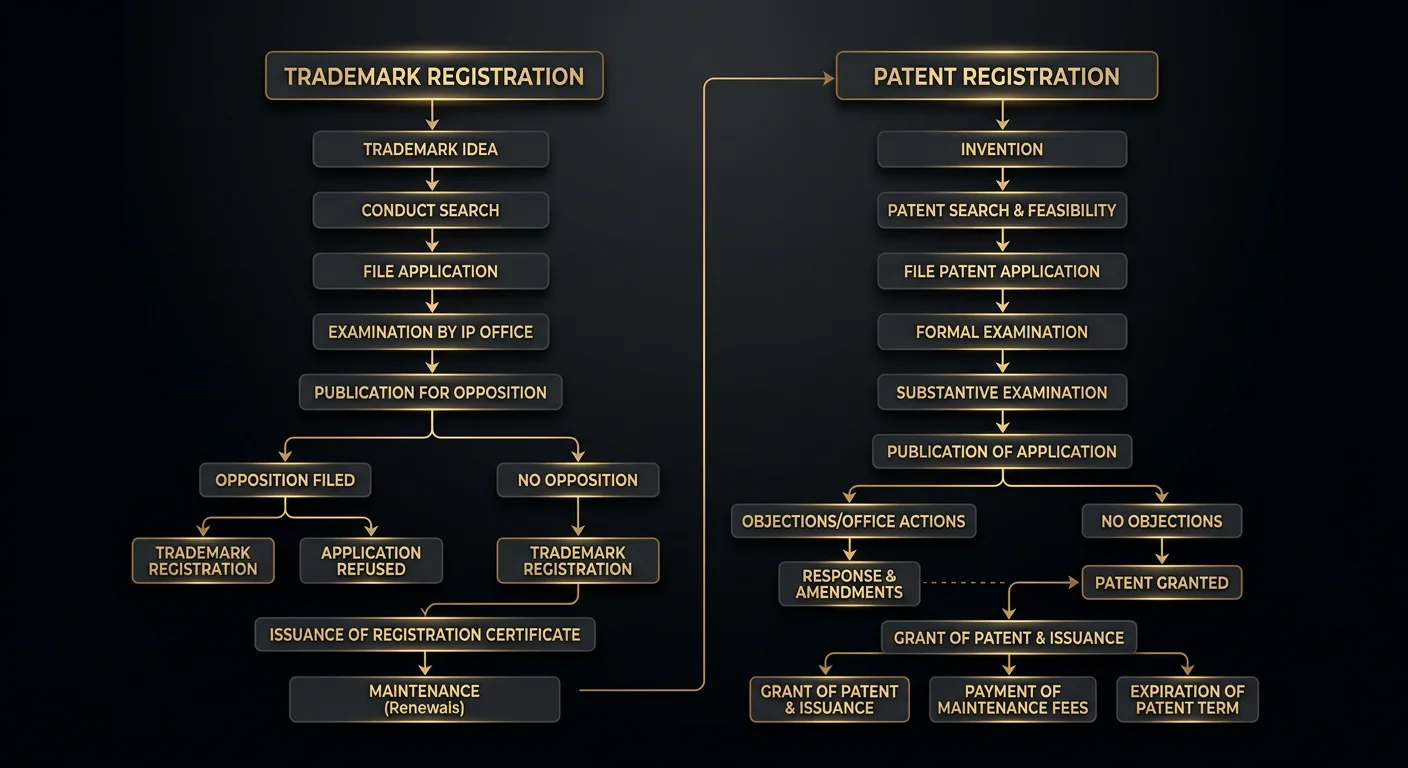
Intellectual property is one of the most valuable assets a business can own. Patents, trademarks, copyrights, and trade secrets each offer different forms of protection, and choosing the right one depends on what you are trying to protect. In Delhi, the IP ecosystem includes the Delhi High Court (which has a dedicated IP division), the Intellectual Property Appellate Board, and the Office of the Controller General of Patents, Designs, and Trademarks.
If you are a startup founder, a creative professional, or a business owner whose product has been copied, understanding how IP law works in India is essential. An IP lawyer in Delhi can help you register, enforce, and monetize your intellectual property rights.
Patents in India
A patent protects new inventions — products or processes that are novel, involve an inventive step, and are capable of industrial application. The Patents Act 1970 governs patent law in India. The application is filed with the Controller General of Patents in Kolkata, but Delhi-based inventors and companies frequently work with Delhi IP lawyers to prepare and prosecute applications.
The patent application process involves: filing a provisional or complete specification, examination request (within 48 months of filing), first examination report, response to objections, grant of patent. The total timeline from filing to grant typically takes 3 to 5 years. Once granted, a patent is valid for 20 years from the filing date, subject to annual renewal fees.
Trademark Registration
A trademark protects brand names, logos, slogans, and other identifiers that distinguish your goods or services. The Trade Marks Act 1999 governs trademark law in India. Registration is filed with the Trade Marks Registry, which has offices in Delhi, Mumbai, Chennai, and Kolkata.

The trademark registration process: trademark search (to check for conflicting marks), filing of application, examination report, response to objections, publication in the Trade Marks Journal, opposition period (4 months), and registration certificate. The entire process takes 18 to 24 months if there are no objections. Once registered, a trademark is valid for 10 years and can be renewed indefinitely.
Copyright Protection
Copyright protects original literary, dramatic, musical, and artistic works, as well as cinematograph films and sound recordings. Under the Copyright Act 1957, copyright arises automatically upon creation — registration is not mandatory but is advisable for enforcement purposes.
Copyright registration in India is handled by the Copyright Office in New Delhi. The application requires a copy of the work, the applicant’s details, and a prescribed fee. Registration takes 6 to 12 months. Once registered, the copyright subsists for the lifetime of the author plus 60 years. Infringement remedies include injunction, damages, and account of profits.
IP Infringement and Enforcement in Delhi
IP infringement in Delhi is primarily handled by the Delhi High Court’s Intellectual Property Division, which has exclusive jurisdiction over patent, trademark, and copyright cases. The High Court can grant injunctions, award damages, and order delivery of infringing goods for destruction.

For trademark infringement, the test is whether the infringing mark is deceptively similar to the registered mark and whether it is likely to cause confusion among consumers. For copyright infringement, the test is whether the infringing work is a substantial copy of the original. For patent infringement, the test is whether the infringing product or process falls within the scope of the patent claims.
Design Protection
The Designs Act 2000 protects the visual appearance of products — shape, pattern, ornamentation, or composition of lines or colours. Design registration is filed with the Designs Office in Kolkata. The registration is valid for 10 years, extendable by 5 years. Design protection is particularly relevant for consumer products, furniture, packaging, and fashion items.
Unlike patents, designs do not protect functional features — they protect only the aesthetic appearance. If your product’s shape is determined by its function, design protection may not be available. In such cases, trademark or copyright protection may offer alternative forms of protection.
Trade Secrets and Confidential Information
India does not have a specific trade secrets statute. Protection is derived from contract law (NDAs and employment agreements), the common law of breach of confidence, and Section 27 of the Indian Contract Act. To qualify for protection, the information must be confidential, have commercial value because it is confidential, and be subject to reasonable efforts to maintain secrecy.
NDAs are the primary tool for protecting trade secrets in India. A well-drafted NDA defines what information is confidential, the duration of confidentiality, the permitted use, and the consequences of breach. Employment agreements should include confidentiality clauses and IP assignment provisions that ensure the employer owns inventions created during employment.
Common Questions
How long does patent registration take in India?
Typically 3 to 5 years from filing to grant. The timeline includes examination (18-24 months), first examination report, response to objections, and grant. Provisional specifications can be filed first, with complete specifications filed within 12 months.
Can I register a trademark without a lawyer?
Yes, but a trademark lawyer can conduct a comprehensive search to identify conflicting marks, draft the application to maximize protection, respond to examination objections, and handle opposition proceedings. DIY applications face higher rejection rates.
What is the penalty for IP infringement in India?
Penalties vary by type. For trademark infringement: injunction, damages up to INR 2 lakh per case, and delivery of infringing goods for destruction. For copyright infringement: imprisonment from 6 months to 3 years and fines from INR 50,000 to INR 2 lakh. For patent infringement: injunction, damages, and account of profits.
Does copyright need to be registered to enforce it?
No. Copyright arises automatically upon creation. However, registration creates a legal presumption of ownership, which is valuable in enforcement proceedings. Without registration, the copyright owner must prove ownership through other evidence, which can be difficult.
Related Practice Areas
- Corporate Law — startup incorporation, IP assignment, FDI
- Cyber Law — digital content protection, software copyright
- Dispute Resolution Delhi — IP enforcement, arbitration
Protecting your intellectual property
Bijlani & Co advises on patent filing, trademark registration, copyright enforcement, and IP disputes across Delhi NCR. Contact us at +91-085958 09471 or write@bijlani.in.
Need a lawyer in Delhi? Consult our advocate in Delhi for comprehensive legal representation. We also specialise in Intellectual Property | Pat matters.
Patent Registration in Delhi
Patent protection in India is governed by the Patents Act, 1970, administered by the Indian Patent Office. A patent grants exclusive rights for 20 years from filing. The process involves filing a provisional or complete specification, publication at 18 months, examination request, and grant. Our IP lawyers in Delhi prepare and file patent applications, respond to examination reports, handle oppositions, and manage post-grant oppositions at the Intellectual Property Appellate Board.
Trademark Registration and Brand Protection
Trademarks protect brand names, logos, slogans, and taglines. Under the Trade Marks Act, 1999, registration is filed at the Trade Marks Registry. The process takes 18-24 months. Our team handles trademark searches, application filing, response to examination reports, opposition proceedings, and infringement litigation before the Delhi High Court.
Copyright Protection in Delhi
Copyright subsists automatically upon creation. Registration under the Copyright Act, 1957 provides prima facie evidence of ownership. Our copyright lawyers handle registration for software code, literary works, cinematograph films, and musical compositions. For infringement matters, we file suits in the Delhi High Court seeking injunctions, damages, and Anton Piller orders.
Design Registration
Industrial designs protect the aesthetic appearance of a product — shape, pattern, ornamentation, or configuration. Under the Designs Act, 2000, registration is valid for 10 years, extendable by 5 years. Our design attorneys prepare and file design applications for consumer products, packaging, fashion accessories, and industrial components.
IP Infringement and Enforcement in Delhi
The Delhi High Court has a dedicated Intellectual Property Division. Our litigation team files suits for permanent injunction, damages, and account of profits. We also pursue criminal complaints under Section 63 of the Copyright Act and Section 29 of the Trade Marks Act for counterfeiting. We assist with customs recordation for border protection.
Technology Transfer and Licensing
IP licensing agreements require careful drafting to define scope, territory, duration, royalties, and quality control. Our lawyers draft and negotiate IP assignment deeds, license agreements, research collaboration contracts, and software escrow arrangements.
Frequently Asked Questions
How long does it take to register a trademark in Delhi?
The trademark registration process in Delhi typically takes 18-24 months. Stages include application filing, examination (2-4 months), response to examination report, publication in the Trade Marks Journal (4 months), and registration.
Can I protect my software code under copyright or patent?
Software code is protected under copyright as a literary work. Copyright subsists automatically. For novel software algorithms, patent protection may also be available. Pure business methods on a computer are not patentable in India.
What is the penalty for trademark infringement?
Trademark infringement attracts civil remedies including injunction and damages. Criminal prosecution can result in imprisonment of 2-3 years and fines up to Rs. 2,00,000 for counterfeit goods.
How do I enforce my patent rights against infringers?
Patent enforcement begins with a notice to the alleged infringer. If ignored, a suit for permanent injunction and damages can be filed before the Delhi High Court.
What is a passing-off action?
Passing-off is a common law tort preventing one business from misrepresenting its goods as those of another. It applies even without trademark registration. We have obtained injunctions in passing-off cases involving trade dress, packaging, and brand names.
Do I need to register my copyright to enforce it?
No. Copyright subsists automatically. However, registration provides prima facie evidence of ownership and strengthens your position in infringement proceedings.
Understanding Patent Law in India
The Patents Act, 1970 governs patent protection in India. To be patentable, an invention must be novel, involve an inventive step, and be capable of industrial application. Software per se, mathematical methods, and business methods are excluded from patentability, but a computer program that provides a technical solution to a technical problem may qualify. Our patent attorneys in Delhi prepare detailed specifications with claims that define the scope of protection. We also conduct prior art searches before filing to assess patentability and reduce the risk of opposition.
Trademark Classes and International Registration
India follows the Nice Classification system with 45 classes. Choosing the correct class or classes is critical — an incorrect class can render a registration ineffective. Our trademark lawyers conduct comprehensive class searches and advise on multi-class filing strategy. For businesses operating internationally, we file applications under the Madrid Protocol through the Indian Trade Marks Registry, enabling protection in 130+ member countries from a single application. We also advise on domain name registration (.in, .com, .co.in) and brand portfolio management.
Copyright Duration and Moral Rights
Under the Copyright Act, 1957, copyright in literary, dramatic, musical, and artistic works subsists for the lifetime of the author plus 60 years. For anonymous works, pseudonymous works, and cinematograph films, the term is 60 years from publication. Moral rights — the right to attribution and the right to integrity — survive independently of economic rights. Our copyright lawyers advise clients on licensing structures that preserve moral rights while enabling commercial exploitation, and we handle infringement disputes involving moral rights violations.
IP Portfolio Management for Businesses
A well-managed IP portfolio is a competitive asset. Our team advises businesses on: conducting annual IP audits to identify protectable assets, filing timely applications for patents, trademarks, and copyrights, monitoring competitor filings for oppositions, renewing registrations before expiry, and enforcing rights against infringers. For startups and SMEs, we design cost-effective IP strategies that prioritize filings based on commercial value and geographic markets. We also advise on employee IP agreements, assignment deeds, and confidentiality clauses to ensure IP ownership is clear from creation.
Alternative Dispute Resolution in IP Matters
Not all IP disputes need to go to court. Domain name disputes can be resolved through the INDRP arbitration process at NIXI. Trademark oppositions are handled administratively before the Trade Marks Registry. Patent oppositions are heard by the Intellectual Property Appellate Board. Our team represents clients in these administrative proceedings, which are typically faster and less expensive than full court litigation. We also negotiate settlement agreements and licensing arrangements to resolve disputes without prolonged litigation.
Delhi IP Court Practice and Procedures
The Delhi High Court’s Intellectual Property Division follows specific case management procedures for IP suits. Interim injunctions are granted based on the balance of convenience and prima facie case. Our team files IP suits with detailed plaints, interim applications for injunction and document discovery, and evidence affidavits. We also handle appeals before the Division Bench of the Delhi High Court and special leave petitions before the Supreme Court. Our familiarity with the IP judges, court procedures, and timelines ensures efficient case management.