Last reviewed: November 19, 2026
Car Accident Lawyer in Delhi NCR | MACT Claims, Insurance |
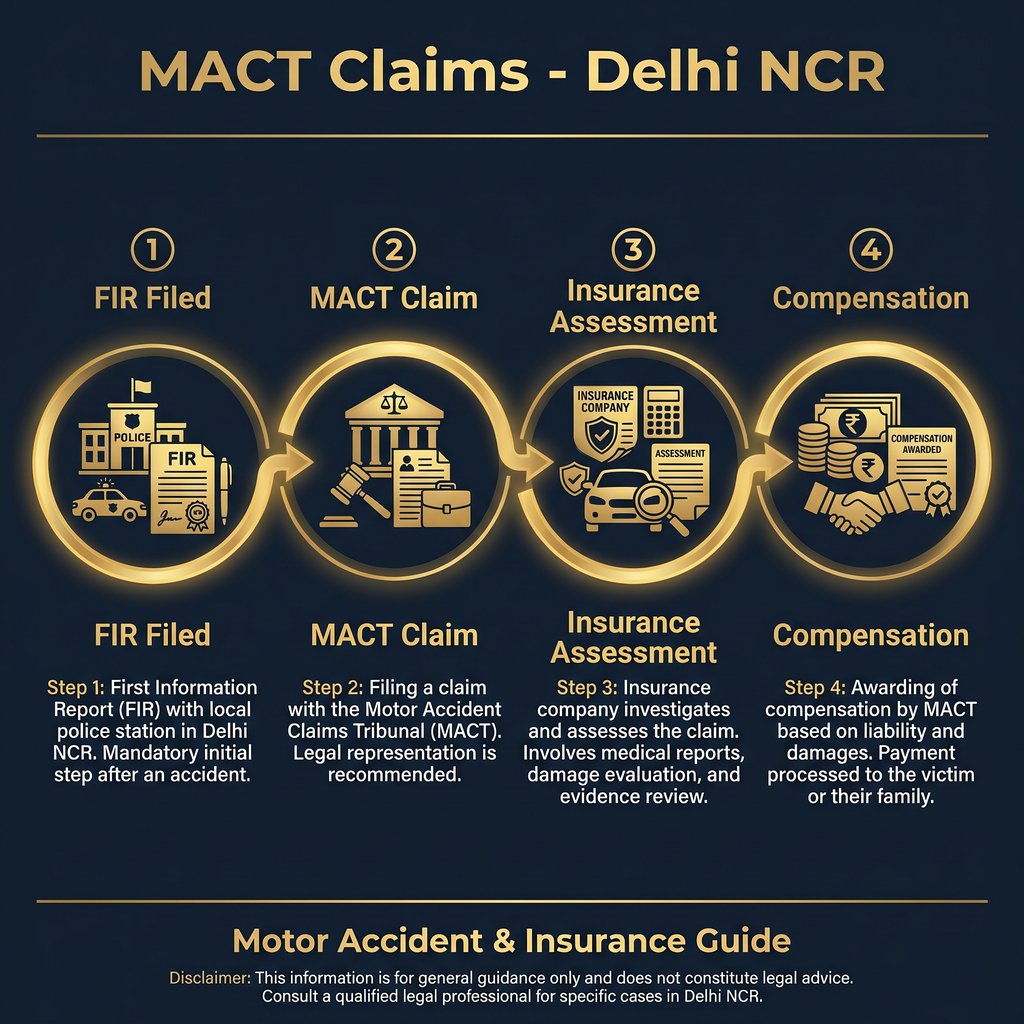
A motor accident claim in Delhi is filed at the Motor Accident Claims Tribunal (MACT) under the Motor Vehicles Act 1939. Adv. Nilesh Bijlani has managed Delhi MACT matters for 15+ years, with a focus on getting the claim to the correct schedule of compensation and the matter to the most efficient forum.
Choosing the right car accident lawyer in Delhi matters because the MACT has jurisdiction over all motor accident claims in the NCR region, and the claim is structured to the specific schedule of compensation and the evidence that supports each head of loss. The difference between a well-managed MACT claim and a delayed one is usually the claim structure and the interim relief strategy. Bijlani & Co. manages MACT claims in Delhi across the Tribunal, with a focus on preserving the client position while keeping the matter on the most efficient procedural track.
The MACT Claim Structure: What It Covers
A MACT claim covers: personal injury compensation, disability compensation, dependency loss where the accident is fatal, and the legal costs. The claim is structured to the specific head of loss and the evidence that supports each one. The compensation schedule is determined by the earning capacity of the injured party, the dependency ratio, the age of the dependants, and the years of working life remaining. We manage the claim to the specific schedule and the evidence that supports each head so the client is not left with an under-compensated judgment. The MACT can order compensation, a refund, and an order for the defective product to be replaced where the facts support it.
The Car Accident Case Lifecycle in Delhi
Every car accident matter in Delhi moves through a defined sequence of procedural steps, and the timing of each step determines the strategy available to the client. Understanding that sequence is what separates a client who is managed through the process from one who is surprised by it. Bijlani & Co. works each Delhi matter stage by stage, so the client always knows what is coming, what it requires, and what the outcome of that stage means for the next.
The first stage is the intake and case-file review: the primary documents, the prior correspondence, the current procedural posture, and the evidence already on record. The second stage is the procedural decision: which forum, which track, and which legal ground. The third stage is the substantive work: the petition or application, the interim orders, the evidence, and the final judgment. Each stage has its own document set, its own filing deadline, and its own leverage point.
Which Forum Handles Car Accident Matters in Delhi, and Why It Matters
The choice of forum is one of the most consequential decisions in a Delhi car accident matter, and it is made at filing, not after. The wrong forum means a transfer, a delay of months, and a procedural position that is harder to recover from. We make that decision at the first application and file at the correct forum from the start.
An advocate who has handled the Delhi docket knows which chambers are faster, which judges grant interim relief more readily, and which procedural traps are specific to the Delhi courts rather than the courts in Delhi or Noida. That local practice knowledge is what we bring to every Delhi matter, and it is what shortens the realistic timeline for the client.
Evidence and Document Preparation for a Delhi Car Accident Matter
Most Delhi matters are won or lost on the evidence file, not on the arguments. A weak evidence file means the court has no material to work with, and the arguments, however well drafted, are built on a foundation that does not hold. We prepare the evidence file to the specific requirements of the Delhi forum: the original documents, the certified copies, the witness statements, and the exhibits, each indexed and marked for the hearing. The evidence file is assembled before the first hearing, not on the day of the hearing.
The documents that typically make up the evidence file in a Delhi car accident matter are: the primary document (the deed, the agreement, the complaint, or the notice that started the matter), the supporting correspondence, the prior orders and judgments, and the current procedural status. Where the matter is at the appeal stage, the appeal file adds the lower court judgment, the record of proceedings, and the grounds of appeal. We assemble each of these in advance so the matter is ready to proceed at the first hearing without a time extension.
When Settlement Is the Right Move in a Delhi Car Accident Matter
Not every Delhi matter should be pushed to judgment. Where the facts support a settlement that preserves the client position, we negotiate it at the point where the procedural leverage is strongest, usually before the trial stage. The settlement is drafted to the specific statutory elements so it is enforceable, and the terms are structured so the client is not left exposed during the pendency of the matter.
Where settlement is not viable, where the opposing party has no intent to negotiate, or where the matter requires a judicial determination because the legal question is genuinely contested, we manage the matter to judgment. The decision to settle or to litigate is made on the facts, not on a preference for either outcome. We advise the client at each stage, and the client makes the decision with that information in front of them.
Timeline and Cost Structure of a Delhi Car Accident Matter
A Delhi car accident matter runs on a timeline that is determined by the forum, the type of matter, and whether any of the procedural stages are contested. These are the realistic timelines, and we plan the matter to them so the client is not surprised by the duration.
Cost is quoted at each stage before the work begins, and the quote is for that stage, not an open-ended hourly rate. The first application, the trial, and the appeal are each quoted separately so the client knows the cost of each stage before committing to it. Where a settlement is reached before the trial stage, the trial-stage cost is not incurred. The cost structure is the same for every Delhi matter.
What to Bring to Your First Delhi Car Accident Consultation
The first consultation is where the matter is assessed and the strategy is set, and it is more effective when the client arrives with the complete document set in front of them.
We identify each risk point at the first consultation and flag it to the client before it becomes case-dispositive.
- The primary document - the deed, agreement, complaint, or notice that started the Delhi matter
- Prior correspondence - any letters, notices, or emails exchanged with the opposing party before the matter was filed
- Prior orders - any court orders, judgments, or dismissal orders from earlier stages of the matter
- Current procedural status - which forum the matter is in, what applications are pending, and the next hearing date
- Payment records - where the matter involves a property or commercial dispute, the payment receipts and the development agreement
Common Mistakes Delhi Car Accident Clients Make - and How to Avoid Them
Most Delhi car accident matters that are lost are lost on procedural errors that were avoidable: a defective filing that does not specify the particular statutory element, a jurisdictional objection that was not raised at the first opportunity, or a settlement that was accepted without the enforceability terms being in the agreement. Each of these is a mistake that is made because the client did not have the procedural information at the moment the decision was made.
- A pleading defect - where the application does not specify the particular statutory provision on which the relief is based, it is vulnerable to dismissal at the first hearing
- A jurisdictional miss - where the matter is filed at the wrong court and the jurisdictional objection is not raised at the first opportunity, the matter is transferred and delayed
- Missing a procedural deadline - where a filing deadline is missed, the right is lost and the matter cannot be recovered at that stage
- Accepting a settlement without enforceability terms - where the settlement is not structured to survive a breach by the other party, the client is back at square one
- Not preserving the appeal route - where the procedural posture at first instance forecloses the appeal, the judgment becomes final when it did not need to be
E-Filing and Digital Court Proceedings in Delhi
The Delhi courts have moved to a hybrid proceeding model: many hearings are conducted through video-conferencing, and e-filing is available for most application types. The practical effect for a Delhi client is that the matter can progress without physical attendance at every hearing, which changes the time cost of the case significantly. The court notice is delivered electronically, the application is filed on the e-court portal, and the hearing is conducted through video-link where the court and the parties are not in the same location.
The e-filing infrastructure at the Delhi courts is not uniform - some application types are still filed physically, and some chambers do not conduct video hearings. We manage the filing to the correct channel for each application so the matter is not delayed by a channel error. Where the matter is at the appeal stage at the High Court, the High Court e-filing system is the relevant channel. We handle both so the client is not managing the filing logistics.
What Happens After the Judgment in a Delhi Car Accident Matter
A judgment is the end of the trial stage, not the end of the matter. After the judgment is delivered, the matter enters the execution stage: the decree is executed against the judgment debtor, the enforcement is completed, and the matter is closed. For a Delhi car accident matter, the execution stage is where the judgment becomes a completed arrangement, and it is where the matter is managed to its final resolution. A judgment that is not executed is a paper victory - the enforcement is what completes the client position.
Frequently Asked Questions
What is a MACT claim in Delhi?
A MACT claim is a claim at the Motor Accident Claims Tribunal in Delhi, where an injured party seeks compensation for personal injury, disability, or death arising from a motor vehicle accident. The MACT has jurisdiction over all motor accident claims in the NCR region, and the claim is filed under the Motor Vehicles Act 1939. We manage the claim to the specific schedule of compensation and the evidence that supports each head of loss.
How long does a MACT claim take in Delhi?
A MACT claim at the Delhi Motor Accident Claims Tribunal commonly concludes in 12 to 24 months. The matter is a summary proceeding, and the tribunal decides it on the materials filed without a full trial. The timeline depends on whether the insurer is willing to settle the matter or whether the claim is pushed to judgment. We manage the claim to the fastest available track and advise the client at each stage on whether the leverage supports a settlement.
What is the maximum compensation for a fatal accident in Delhi?
There is no statutory maximum for a fatal accident claim at the MACT in Delhi. The compensation is determined on the basis of the deceased earning capacity, the dependency ratio, the age of the dependants, and the years of working life remaining. In practice, courts award between INR 50 lakh and INR 2 crore for a fatal claim, depending on the specific facts. We assess the realistic range for a specific Delhi matter at the first consultation.
Explore More From Bijlani & Co
- Personal Injury Lawyer in Delhi
- Car Accident Lawyer in Delhi
- Consumer Court in Delhi
- Why Car Accident Clients in Delhi Choose Bijlani
Discuss your car accident matter in Delhi with Bijlani & Co. | Patiala House, New Delhi | Contact
Related Resources
- Advocate Near Me in Delhi NCR | Find a Lawyer in Delhi, |
- Bankruptcy & IBC Resolution Lawyer in Delhi | CIRP, |
Related Service Pages:
Areas We Serve in Delhi
Bijlani & Co. serves clients across Delhi, including the following localities and sectors:
- Connaught Place
- Punjab Bagh
- Karol Bagh
- Daryaganj
- New Delhi
- Lajpat Nagar
- Rajouri Garden
- Rohini
- Dwarka
- Saket
- Vasant Kunj
- Greater Kailash
- Hauz Khas
- Chanakyapuri
- Majlis Park
- Nehru Place