Divorce & Judicial Separation | Family Lawyers Delhi NCR
Divorce in Delhi: A Complete Guide to the Legal Process

Divorce in India follows personal laws that change depending on your religion, the type of marriage, and where you file. In Delhi, family courts handle these cases with established procedures that take time to understand. This guide covers the grounds for divorce, the mutual consent process, child custody, maintenance, and what you can expect at each stage.
Grounds for Divorce
Under Section 13 of the Hindu Marriage Act 1955, divorce can be obtained on several grounds: cruelty, desertion for two or more years, adultery, conversion to another religion, unsoundness of mind, venereal disease, renunciation of the world, and presumed death. The most commonly invoked grounds in Delhi family courts are cruelty and desertion. Adultery requires evidence that is difficult to produce, which is why cruelty — physical or mental — is the preferred ground in contested cases.
For marriages registered under the Special Marriage Act 1954, the grounds are similar but the procedure differs. For Muslim marriages, the Dissolution of Muslim Marriages Act 1939 applies. For Christian marriages, the Indian Divorce Act 1869 governs. A family lawyer in Delhi can advise which law applies to your situation and which ground offers the strongest case.
Mutual Consent Divorce
Mutual consent divorce is the fastest way to end a marriage in India. Under Section 13B of the Hindu Marriage Act, both parties must agree, have lived separately for at least one year, and confirm they cannot continue the marriage. The process: file a joint petition, attend a first motion hearing, complete a mandatory six-month cooling-off period, and attend a second motion hearing.

A recent Delhi High Court ruling clarified that the one-year separation period is not mandatory in every case. Courts can waive the cooling-off period if the marriage has irretrievably broken down and there is no prospect of reconciliation. This has reduced timelines from 18 months to as little as 6 months in appropriate cases.
At the hearing, the court checks that consent is free and voluntary. It may ask each party separately whether they still wish to proceed. If both confirm, the court grants the decree. Maintenance, child custody, and property division are addressed in the petition or through a separate settlement agreement.
Contested Divorce
When one party does not agree, the process becomes contested. The petitioner files on specific grounds, and the respondent files a written statement contesting the allegations. The court frames issues, records evidence, and hears arguments. Contested divorce in Delhi takes 3 to 5 years, depending on case complexity and court schedules.
Grounds like cruelty require evidence — medical records, witness testimony, or documented incidents. Desertion requires proof of continuous absence for two years without reasonable cause. A family lawyer helps build the evidentiary record and present it effectively.
Child Custody
Delhi family courts apply the welfare of the child principle as the paramount consideration under Section 26 of the Hindu Marriage Act and the Guardians and Wards Act 1890. The court examines: the child’s age and emotional bond with each parent, each parent’s ability to provide a stable environment, the child’s educational needs, and the child’s own preference if old enough to express it.
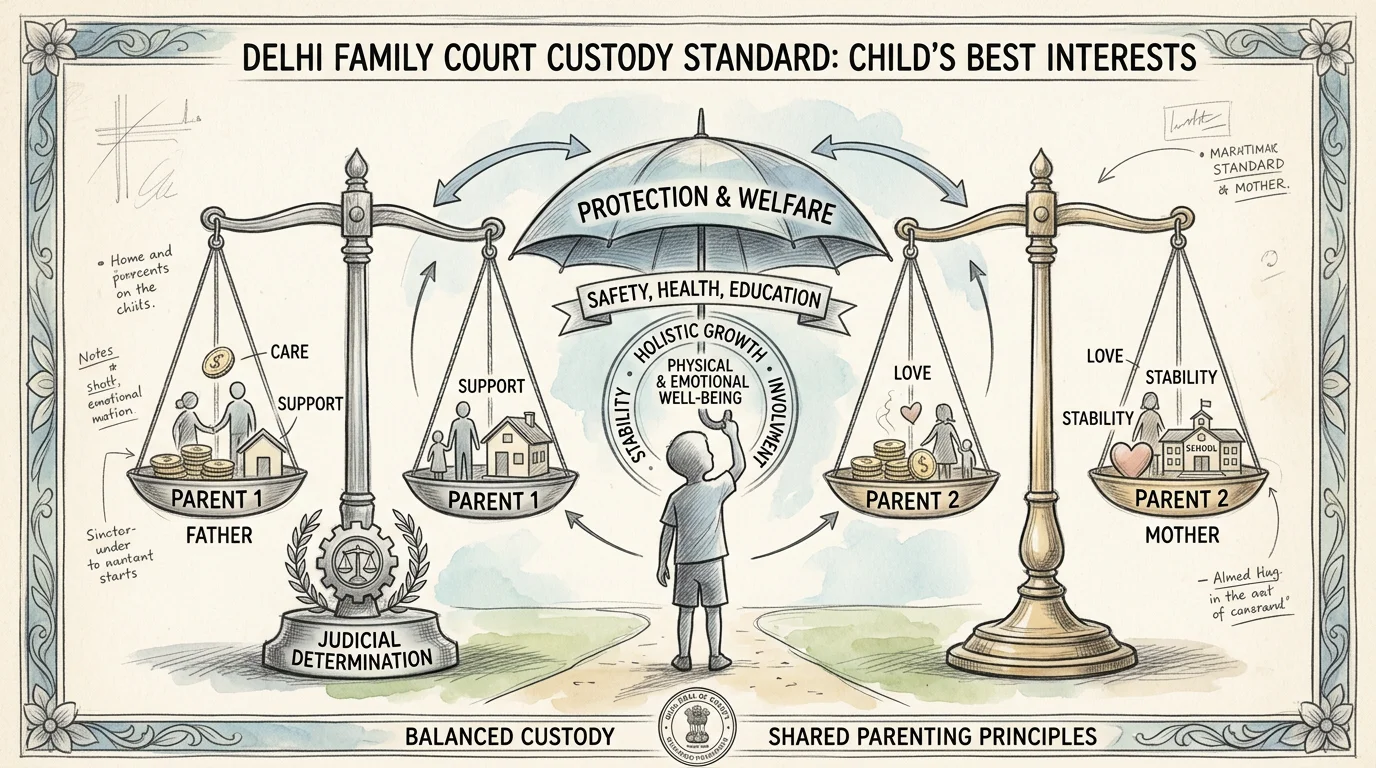
For children under five, courts generally favour the mother unless there are compelling reasons otherwise. For older children, the court considers existing living arrangements, schooling, and relationship with both parents. Joint custody arrangements are becoming more common, though terminology varies — what matters is that both parents remain involved.
Maintenance and Alimony
Under Section 125 CrPC, a spouse unable to maintain themselves can claim maintenance from the other spouse during proceedings and after the decree. The amount is based on earning capacity of both parties, the standard of living during the marriage, and the needs of any children.
Under Section 24 of the Hindu Marriage Act, a spouse can claim pendente lite expenses during proceedings — covering legal costs and living expenses while the case is ongoing. At the final decree, permanent alimony is determined on similar grounds. Delhi courts have become more nuanced in recent years, considering both parties’ earning capacities rather than automatically ordering the husband to pay.
Property and Stridhan
Property division in India does not follow a fixed formula. The court considers each party’s contribution — financial and non-financial — to the marriage and asset acquisition. Stridhan, gifts received by the wife at or after marriage, is her absolute property and must be returned on divorce. Matrimonial property acquired during marriage through joint effort is divided based on the court’s assessment of contribution.

Timeline
Mutual consent divorce takes 6 to 18 months in Delhi family courts. Contested divorce takes 3 to 5 years, including appeals. Maintenance applications can be decided within a few months. Child custody matters resolve within 6 to 12 months if both parents cooperate. Preparation, documentation, and experienced counsel affect the timeline at every stage.
Common Questions
How long does mutual consent divorce take in Delhi?
Typically 6 to 18 months. The Delhi High Court has relaxed the one-year cooling-off period requirement in cases where the marriage has irretrievably broken down, bringing timelines down to 6 months in appropriate cases.
Can a wife claim maintenance during divorce proceedings?
Yes. Under Section 125 CrPC, a spouse unable to maintain themselves can claim maintenance during proceedings and after the decree. Under Section 24 of the Hindu Marriage Act, pendente lite expenses can be claimed during the proceedings.
What is stridhan and can it be recovered after divorce?
Stridhan refers to gifts received by the wife at or after marriage. It is her absolute property. Under Section 27 of the Hindu Marriage Act, the court can order return of stridhan on divorce.
How is child custody decided in Delhi?
Delhi family courts apply the welfare of the child principle as paramount. Factors include the child’s age, emotional bond with each parent, each parent’s ability to provide stability, and the child’s own preference if old enough. For children under five, the mother is generally preferred unless there are compelling reasons otherwise.
Related Practice Areas
- Family Law — divorce, custody, maintenance, domestic violence
- Civil Law — property disputes, contract disputes, injunctions
- Dispute Resolution — mediation and arbitration for family settlements
Family law matters require sensitive handling
Bijlani & Co has extensive experience across Delhi family courts in divorce, custody, and maintenance matters. Contact us at +91-96549-26593 or write@bijlani.in for a confidential consultation.